Wednesday, June 15, 2016

Lovecraftian Thing a Day No.167: The Encyclopedia Cthulhiana


On day 3 of Chaosium Week, we present The Encyclopedia Cthulhiana by the inestimably talented Mr Dan Harms (whose talk at Treadwells Bookshop I hope to attend during Dan's coming trip to the UK). This tome has been of immeasurable help to scholars and afficianados of the Cthulhu Mythos, as well as serving as a source of inspiration for Call of Cthulhu Keepers aplenty, and I think I'm correct in saying that it found it's first home in Chaosium's Mythos fiction line. Regardless, if you are a fan of the Cthulhu Mythos this book deserves a place in your collection.

Tuesday, June 14, 2016

Lovecaftian Thing a Day No.166: Mysteries of the Worm


In day 2 of Chaosium Week, we present Robert Bloch's Mysteries of the Worm. This was the scond in the series of Chaosium's Cthulhu Mythos fiction line (the first being The Hastur Cycle). As with yesterday's offering, this was another key publication - bringing back into circulation as it did Bloch's otherwise very difficult to find (at least for us in the UK) collection of Mythos tales. Also of note is  the erudite introduction and commentary to this and other volumes, provided by Robert M. Price who, to my mind, produced at the timr some outstanding academic analysis of the Lovecraftian fictional milieu.

Monday, June 13, 2016

Lovecraftian Thing a Day No.165: The Xothic Legend Cycle


By way of a belated 'happy birthday', today's item is The Xothic Legend Cycle: The Complete Mythos Fiction of Lin Carter (born June 9th 1930); this also kicks off Chaosium Week for the Lovecraftian Thing a Day, where will survey a selection of the fiction books that Chaosium have been producing since the early 1990s. The Xothic Legend Cycle was notable because most of its contents were not readily available elsewhere, and the republication of Carter's Mythos tales enabled a new generation engage with his and others' work in this field. To this end Chaosium's fiction line effectively revived and revitalised the Cthulhu Mythos literary scene in the 1990s, making available again many fine (and some, admiitedly, not so fine) stories which had, in many cases, been long out of print. Chaosium, we salute you!

Sunday, June 12, 2016

Lovecraftian Thing a Day No.164: NecronomiCon 2013 Commemorative Art Print


Lovecraftian Art Week reaches its conclusion today with this limited edition art print by Dean Kuhta, commissioned to commemorate NecronomiCon 2013 (where I purchased this fine piece). Apparently a small number of these prints are still available to purchase fom Lovecraft Arts and Sciences - please do support them to ensure that NecronomiCon will continue to be an ongoig coneern.

Saturday, June 11, 2016

Lovecaftian Thing a Day No.163: Nicholas Roerich


For day 6 of Lovecraftian Art Week I present a selection of postcards of Nicholas Roerich's work, which I picked up from the Nicholas Roerich Museum in New York a few years back (and absolutely worth a visit if you are ever in NY). Whilst obviously not  depicting Lovecraftian subjects per se, some of the images shown here are likely the ones that Lovecraft used as inspiration for At the Mountains of Madness.

Friday, June 10, 2016

Lovecraftian Thing a Day No.162: Ramsey Campbell Portrait


On day 5 of Lovecraftian Art Week I present a colourised print of Allen Koszowski's characterful portrait of Ramsey Campbell, which I was able to purchase directly from Allen during NecronomiCon 2013, and which also acknowledges Campbell's Severn Valley mythos. Nice.

Thursday, June 09, 2016

Lovecaftian Thing a Day No.161: The Music of Erich Zann


On day 4 of Lovecraftian Art Week, I present this mounted print of a very fine piece by Mr. Jim Pitts illustrating The Music of Erich Zann, and hinting at the horrors that were forestalled - even into death and whatever state lies beyond - by that gentleman's continued playing.

Wednesday, June 08, 2016

Lovecraftian Thing a Day No.160: 'A Huge, Formless White Polypus Thing'


I'm unsure of the provenance of this print, whch I picked up in the early 2000s in Brighton, UK. I believe it is supposed to represent the 'huge, formless white polypous thing with luminous eyes' mentioned in The Call of Cthulhu as inhabiting a hidden lake deep within the Louisiana Bayou - and is one of only a few artistic renditions of that nameless monstrosity that I have thusfar encountered...

Tuesday, June 07, 2016

Lovecraftian Thing a Day No.159: Lovecraftian Portal


In day 2 of Lovecraftian Art Week, I present an original painting by Steve Lines, and which was used as the cover of one of Rainfall Books' chapbook series (possobly an issue of Lovecraft's Disciples). I'm afraid I have no idea what the title of this beautifully weird piece is, so for the purpose of this post I have referred to it as s Lovecraftian portal.

Monday, June 06, 2016

Lovecraftian Thing a Day No.158: The Tomb Herd (Art Week Day 1)


This week marks the beginning of a dedicated Lovecraftian Art week, where for the next seven days Ill be showcasing a sample of the various Lovecraftian drawings, paintings and prints that I own. First up is a print entitled The Tomb Herd (illustrating a scene from Ramsey Campbell's 'The Church on High Street') from the pen of Mr Dave Carson.

Sunday, June 05, 2016

Lovecraftian Thing a Day No.157: The Compleat Crow


We round off Brian Lumley Week with The Complete Crow, collecting Lumley's short stories concerning the eponymous antagonist to the Cthulhu Mythos. Titus Crow is probably my favourite of Lumley's creation, in part because he represents one of the more contemporary manifestations of the literary tradition of the occult investigators (whose number also include such luminaries as John Silence, Thomas Carnacki, Jules de Grandin, and Anton Zarnak) for which I maintain a fondness. The stories collrcted her span the entirety of Crow's career, including his inception as well as the aftermath of his mysterious disappearance. Interestingly, the Mythos does not loom large in all of the tales, some of which document Crow's encounters with more earthly revenants. The book is now avaible in electronic and audiobook formats (the latter of which is s current listening favourite at Ghootoc Zone central). In any case, the collection forms a fine bookend to Crow's novelised adventures, and a nice way to bring Brisn Lumley Week to a close.

Saturday, June 04, 2016

Lovecraftian Thing a Day No.156: Khai of Ancient Khem


I don'r even know where to begin when trying to describe this: Lumley's take on a kind of Howardian sword-and-sorcery (although in this case more science fantasy) action tale, set amidst an earthly 'lost' civilisation that is the precursor to ancient Egypt. Mix in lots of sex and violence (the eye-watering incident involving a pair of bronze false teeth which merges both comes to mind), ancient aliens, time travel, with the Cthulhu Mythos lurking in the background, and you have the glorius pulpy goodness that is Khai of Ancient Khem. The plot, though convoluted, is at heart fairly straight forward: the manly, muscular hero Khai seeks revenge against the pharaoh Khasathut for murdering his family, and manages to win the heart of a beautiful princess on the way to doing this. Amidst all this pulpy fun there is, however, one big criticism, and that is the thread of heteronormative homophobia (sadly indicative of a good deal of 70s and 80s horror) running through the book (the incident with the aforementioned bronze false teeth being a case in point) - think the kind of Othering found in Zak Synder's rendition of Frank Miller's 300, where the bad guys are portrayed as physiognomically monstrous sexual deviants. I may very well be looking at this from a 21st Century sensibility, but it is nonetheless an issue which readers should be aware of (and no doubt one that will infuriate those who think Lovecraft's racism doesn't matter...).

That aside, regular readers may be aware of my academic interest in tracking the influence of the Lovecaftian milieu upon contemporary pop culture. Given that it was first published in 1980 (and well before the Stargate franchise popularised these ideas), Khai of Ancient Khem contains many elements that have become a normative part of contemporary (online) paranormal occultures: ancient/lost civilisations mixed in with the belief held by some 'alternative' archaeologist that the Sphinx and the pyramids are much older than the archaeological mainstream claims; ancient but anachronistic technologies; ancient aliens, and human-alien hybridisation programmes. Admittedly all of these ideas were floating around prior to 1980, and certainly at that point the idea that aliens built the pyramids was nothing new. I'm not, then, suggesting that Lumley's book gave rise to these beliefs; it does, however, seem seem a little prescient in terms of bringing together a range of themes that probably didn't begin to coalesce within the mainstream of pop and paranormal cultures until the 1990s - so I'm wondering if Khai of Ancient Khem may have played a very small role in popularising these ideas and their intersection.

Friday, June 03, 2016

Lovecraftian Thing a Day No.155: Synchronicity, Or Something.


Today I offer something of a rarity: a signed copy of the Brian Lumley chapbook Synchronicity, Or Something, illustrated by Dave Carson and published by Dagon Press. Its been a while since I last read this, so the details of the tale are a bit vague, but I beleve it is one of the earlier examples of a kind of subgenre of weird tale where authors present a parodic view of literary horror conventions, often including barely-disguised caricatures of well-known horror writers in the cast of characters. Other contributors to this subgenre include Karl Edward Wagner and, more recently, Laird Barron; I seem to recall Ramsey Campbell having done something of the sort also. Regardles, this is a fun little piece which documents what happens when an actual manifestation of the Cthulhu Mythos occurs during an H.P. Lovecraft convention.

Thursday, June 02, 2016

Lovecaftian Thing a Day No.154: The Burrowers Beneath Redux


We return to The Burrowers Beneath today, but on this occasion via a visual medium: a print depicting a key scene from that novel, to be precise - and by no less a Lovecraftian luminary than Mr Dave Carson. Enjoy.

Wednesday, June 01, 2016

Lovecraftian Thing a Day No.153: Return of the Deep Ones


At the risk of contradicting myself re: yesterday's post, I think that Return of the Deep Ones is my favourite (non-Crow) Lumley tale. Whilst the novella effectively reproduces key elements of 'The Shadow Over Innsmouth' in a UK setting, it nonetheless contains excellent moments of a peculiar kind of weird horror that Lumley seems apt to produce in his best work - especially when he abandons or ignores (as he does here) the Derlethian trappings of his other Mythos tales. This collection also contains a reprint of Beneath the Moors, one of Lumley's earliest works that was first published by Arkham House (I used to own that edition, but sadly sold it many years ago when i think a younger, more foolish me was going through a bit of an anti-Lumley phase).

Tuesday, May 31, 2016

Lovecraftian Thing a Day No.152: Mythos Omnibus Volume One


In day two of Brian Lumley week I present the first volume of Lumley's two Mythos Omnibuses (is that a word?), which contains (yet again) The Burrowers Beneath, The Transition of Titus Crow and The Clock of Dreams, which together comprise the opening trilogy to what would eventually comprise a series of at least nine interlinking books, throughout which Lumley continues the work of Derleth in attempting to systematize the Cthulhu Mythos.

In any case, The Transition of Tius Crow - a direct sequel to The Burrowers Beneath - remains one of my favourite Lumley works, and in part because our eponymous hero becomes a veritable Mythos-bashing Doctor Who-like figure, flying around time and space in a clock (the weird alien one from 'Through the Gate of the Silver Key') which is bigger on the inside than on the out. Despite how bad that sounds, Transition is rip-roaring pulpy goodness, and even manages to occasionally evoke a sense of the cosmic - dealing as it does with Crow's travels through vast swathes of time and space.

Admittedly Lumley is unable to sustain this on account of his insistence on subjecting the Mythos to a Derlethian moral dualism; the Mythos is, however, both big enough and strange enough to encompass multiple philosophies (even if they are diametrically opposed), so I for one remain unashamedly a fan of Lumley. Just don't mention Kthanid.

Monday, May 30, 2016

Lovecraftian Thing a Day No.151: The Burrowers Beneath (Day 1 of Brian Lumley Week).


Brian Lumley can be quite a polarizing figure when it comes to the Cthulhu Mythos, insofar as his work in the field tends to reiterate and develop upon the Derlethian 'heresy' - an issue I mean to explore over the coming week. In any case, I retain fond memories of Lumley's The Burrowers Beneath, if only for the fact that it was my first encounter with a Cthulhu Mythos novel by someone who was part of the 'new' Lovecraft circle. In actuality, I quite like Burrowers - it moves along at a fine pace, and contain some moments of genuinely weird horror; it also introduces Titus Crow, a character for whom I have retained a fondness since encountering him here. Sadly, the copy shown here is not the original Grafton UK edition which I picked up in the late 1980s, but an earlier US paperback edition which I purchased more recently.

Sunday, May 29, 2016

Lovecraftian Thing a Day No.150: Shoggoth


To celebrate the 150th post of the Lovecaftian Thing a Day series, I present one of the most remarkable and treasured objects in my collection: an original and unique artwork - which I believe is entitled 'Shoggoth' - produced by the hand of Mr. Dave Carson. I possess many fine and strange things, some of which harbour equally strange properties - but none moreso than this.

I cannot speak as to the manner and circumstances surrounding the creation of this piece, but having spent many long evenings carefully surveying the effigy's weirdly carved contours, it is evident that occult means were employed in its design: the sculpture operates as a kind of psychic gateway or conduit, which opens the inner eye not only to visions of a vast, snowy plateau beyond which looms ominously a range of black, needle-like cyclopean mountains, but also to intimations of monstrous things buried deep within those peaks  - things which lay coldly dreaming, and whose slumber is best not disturbed.

Saturday, May 28, 2016

Lovecaftian Thing a Day No.149: William Hope Hodgson


There is a common misconception that a common narrative trope informing much of Lovecraft's work is that of the beleaguered narrator, desperately typing away in an attempt to reveal to the world the horror that at this very moment fumbles monstrously at the latch of my study door...

Well, you get the idea. As I recall, the closest Lovecraft comes to this is in Dagon; in fact it is a conceit that is not original to Lovecraft, but one of his literary forebears: William Hope Hodgson employs it in The House on the Borderland. Mention of Hodgson is long overdue here, so today I present two of his classic works, and ones which not only prefgure Lovecraft's cosmicism but have arguably had something of an influence on HPLs work (but see the comment below): The Night Land and the afoementioned The House on the Borderland. Enjoy.

Friday, May 27, 2016

Lovecraftian Thing a Day No.148: Lovecraft at Last


Today's selection is Lovecaft at Last, the collected correspondence of H.P. Lovecaft and Willis Conover, which includes facsimiles of some of the original letters. This is the 2002 edition (the first being published in 1975). I have no idea from where I picked this up, but seem to recall acquiring it close to the date of publication, so I suspect it may have been a purchase from the venerable (and, since its demise, much lamented) Fantasy Centre in London. I was a bit rushed putting this post together, so haven't had a chance to fact-check, but I think I am correct in stating that the famed 'History of the Necronomicon' appeared in one of Lovecraft's letters to Conover, and is included in this volume.

Thursday, May 26, 2016

Lovecraftian Thing a Day No.147: H.P. Lovecraft Memorial Square Plaque Fridge Magnet


This is a replica (in the form of a fridge magnet) of the plaque which now graces the H.P. Lovecraft Memorial Square in Providence - not far from Prospect Terrace, one of Lovecraft's favourite haunts (I find myself suddenly taken by a strange, melancholic nostalgia just thinking about that spot). I imagine that Lovecraft would marvel at the fact that he'd be remembered within his beloved Providence in such a manner. In any case, this is produced by Gage Prentiss, creator of the actual plaque, and it remains a fond reminder of my last visit to the Sunset City.

Wednesday, May 25, 2016

Lovecraftian Thing a Day No.146: Dave Carson Original Art


This is an original artwork by Dave Carson which I picked up a good few years ago, such that I've since forgetten the title of the piece - although I think it is supposed to depict one of Nyarlathotep's monstrous forms. It current hangs on the wall of my Sanctum Sanctorum, above a bust of Lovecraft.

Tuesday, May 24, 2016

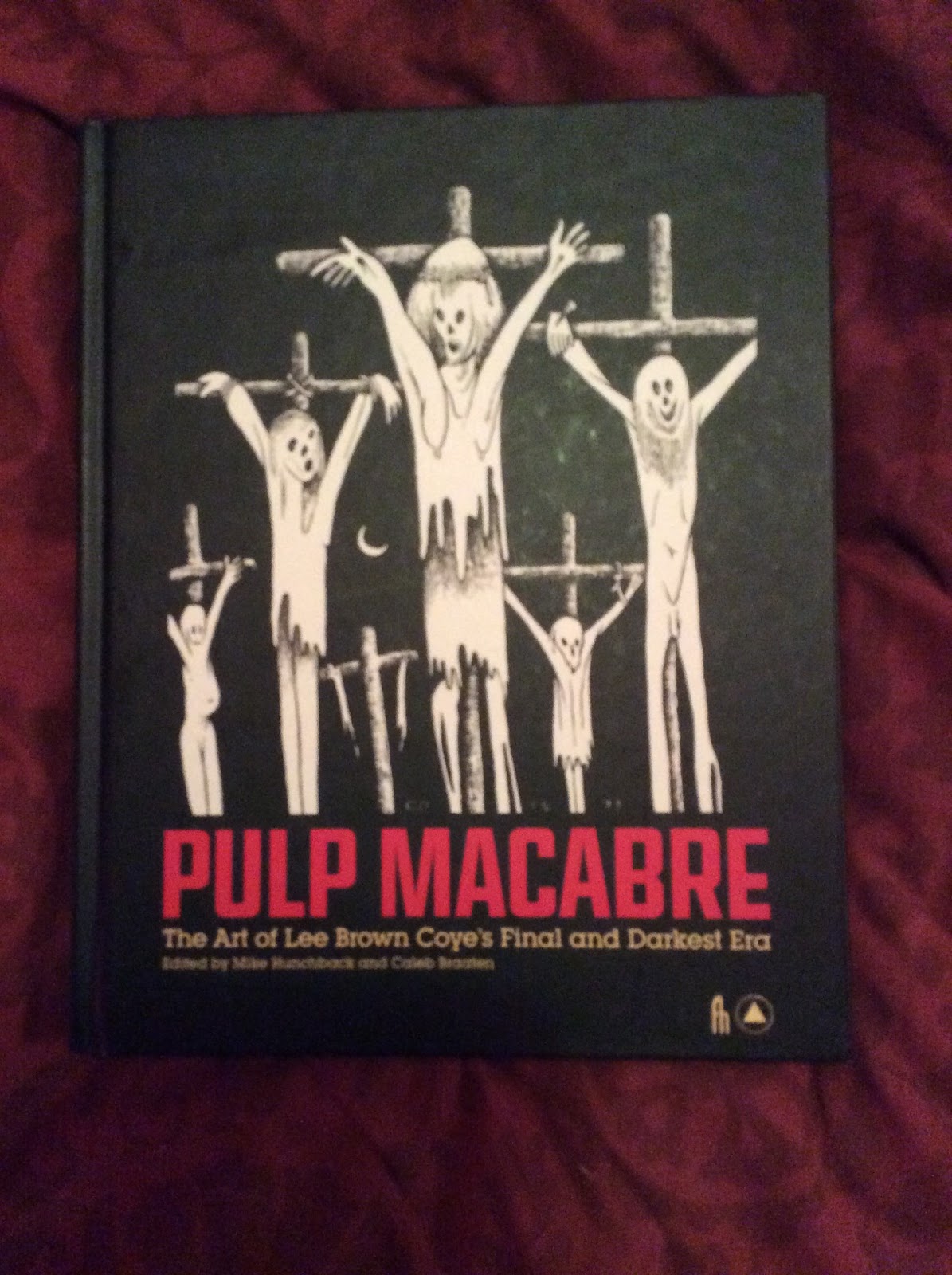
Lovecraftian Thing a Day No.145: Pulp Macabre - The Art of Lee Brown Coye's Final and Darkest Era


Another NecronomiCon 2015 purchase, Pulp Macabre presents a wide selection of famed Lovecraftian illustrator Lee Brown Coye's later work. I've always been a huge fan of Coye's style - the peculiar derangements which he subjects the human form to in his illustrations marks him out as a master of the weird. Coye's work is probably best known from the covers of various classic Arkham House collections (notably Dagon and At the Mountains of Madness); the strange, recurrent stick-like motifs that pepper his art also inspired Karl Edward Wagner to write his highly-regarded Cthulhu Mythos tale 'Sticks'. Nice.

Monday, May 23, 2016

Lovecraftian Thing a Day No.144: Arthur Machen's 1890s Notebook


This weekend I was fortunate enough to be one of a small number of people (300 or less) to receive The Friends of Arthur Machen/Tartarus Press' joint publication of Arthur Machen's 1890 Notebook, which, I understand, includes (amongst other things) notes on Machen's classic weird tale (and one of Lovecraft's favourites) 'The White People'. This along with yet another hardback copy of Faunus (the Journal of the Friends of Arthur Machen), as well as Machenalia (the Newsletter of the Friends of Arthur Machen). Aside from wonderful gifts like the Notebook, you too can receive Faunus and Machenalia twice yearly for just twenty-five of your finest English pounds. Join The Friends of Arthur Machen today - you know you want to.

I'm also very pleased to hear that the Friends will be holdng their AGM/annual dinner in honour of Machen in London next year, which I mean to attend - with NecronomiCon also on the horizon, it's looking like 2017 is going to be very exciting indeed.

Sunday, May 22, 2016

Lovecraftian Thing a Day No.143: A Touch of Evil


Today's item is not the title of a well-known Orson Welles movie, but rather Flying Frog Productions' game of supernatural horror and investigation. Whilst A Touch of Evil is somewhat akin to Arkham Horror, initial impressions might indicate this is more Washington Irving than H.P. Lovecaft - Sleepy Hollow the boardgame, if you like - insofar as the game is set in the early 1800s and has a 'colonial gothic' feel. In any case, the game is premised on players taking the role of diverse investigators seeking to unearth, confront and thwart various supernatural evils plaguing the New England village of Shadowbrook. On closer inspection, Lovecraftian elements do reveal themselves, although they are primarily to be found in the game's two big box expansions: the first of which introduces an antagonist bearing more than a passing resemblance to a Deep One/the creature from the black lagoon, along with a cult worshipping a betentacled Unspeakable Horror from Beyond Time and Space; the second coastal-themed expansion introduces encounters with a kraken and provides more by way of Deep One fare in the form of 'the Children of the Deep'. Afficianados of the classic 'undead pirate' trope will also not find themselves disappointed.

While there are indeed gameplay comparisons to be made with Arkham Horror, A Touch of Evil is lighter and with a shorter playing time, meaning it is more likely to hit my table than Arkham. As with previous entries, production values are also very high here, and the game uses a rather unusual art style comprised of photos of actors in period costume or made-up/photoshopped to look like the various antagonists. Some gamers have taken issue with this, but I rather like the conceit. One downside - indeed a problem I have regarding many modern boardgames - is the inclusion of miniatures in A Touch of Evil. It appears to be a common assumption amongst gamers today that a boardgame's quality is proportionate to the number of plastic miniatures which come packed in its box - regardless of the fact that, to all intents and purposes, miniatures remain functionally useless in in many boardgames. In miniature wargaming, miniatures are meanigfully used to simulate or represent the actual physical conditions of warfare, such as combat range and line-of-sight. Since these concepts are often abstracted (or don't apply at all) in may boardgames, miniatures have no purpose other than to act as glorified counters or markers. In this respect, I find that grey plastic miniatures often detract from the aesthetics of a boardgame, necessitating on my part the painting of the damned things in order to create an aesthetically pleasing experience. Fortunately A Touch of Evil only has 8 miniatures in the base game (and thusfar I have only bothered to paint two of them); these could, however, quite easily have been replaced by something akin to the pleasingly attractive cardboard standee markers found in most of Fantasy Flight Games' Lovecraftian boardgames. Alas, the obsession with miniatures in boardgames shows no sigh of abating, so I guess I will just have to live with it...

Saturday, May 21, 2016

Lovecraftian Thing a Day No.142: Ancient Terrible Things!


Ancient Terrible Things is a yahtzee-style dice-rolling game of Lovecraftian pulp horror, where players travel around a stylised board representing weird locations along a mysterious jungle river, seeking to unlock arcane secrets whilst avoiding awakening various ancient terrible things from their aeons-long slumber. The game has quite a unique visual style which fits the theme extremely well, with top-notch components as far as production values are concerned (after The Witch of Salem, this contains what is probably my second-favourite gaming board). That said, Ancient Terrible Things is mechanically similar to Elder Sign, which of the two is my preferred game. The first expansion to Ancient Terrible Things (The Lost Charter) adds solitaire play as well as components that allow you to play the game in a travel format minus the board, which is a nice addition. Not my favourite game of Lovecraftian horror, but one that still occasionally hits my gaming table.

Friday, May 20, 2016

Lovecraftian Thing a Day No.141: Shadows over Normandie


Undead Nazi occultists seeking to unleash monstrous powers from beyond time snd space? Check. Deep Ones? Check. Shoggoths? Check. Extra-large full-colour counter representing Cthulhu, should I be foolish enough to try snd take him on with a platoon of British commandos or the 101st Airborne? Check. Hellboy - oh, sorry, I meant the non-IP infringing 'Devil Boy' counter with which to kick aforementioned undead Nazi ass? Check. If any of the above sound appealing, then you'll be eanting Shadows over Normandie, the World War 2 squad level tactical wargame of Lovecraftian horror by Devil Pig Games, and which is also a boardgame tie-in to Modiphius' wonderfully named Achtung! Cthulhu rpg. You can even get in-game counters for Lovecraft (wonder which side he'll be fighting on...) as well as Herbert West (who of course allows you to introduce squads of reanimated undead into the game). This ticks so many boxes for me that, with the purchase of this game, my life is pretty much close to being complete.

Thursday, May 19, 2016

Lovecraftian Thing a Day No.140: De Profundis


Michal Oracz's De Profundis is somewhat remarkable in being a game of Lovecraftian letter writing. Ostensibly a kind of rpg, players participate in a process of shared Lovecraftian world-building and storytelling via the epistolary medium. On which point, Oracz's is at pains to point out that the game should, ideally, involve the actual handwriting (or typing, preferably using a vintage typewriter) and physical sending of letters - and indeed other artefacts - through the post. Understandably, the rules governing this type of play-by-mail LARPing operate less as such and more as a set of guidelines - especially as it is anticipated that games will be resolved when one or more of the participants (or at least their literary alter-egos) come to some vaguely horrific end.

Interestingly, De Profundis is just one facet of a wider trend within the Lovecraftian milieu; here I am thinking of the kinds of narratively-backgrounded objets d'art produced by the likes of the HPLHS (as well as other Lovecraftian sculptors), along with more recent endeavours such as the Mysterious Package Company. And of course, much of this harps back not only to a kind of 'folk history' of the production of Lovecraftian material culture within the gaming community (in the form of unique and often beautifully-crafted player handouts), but also to Lovecaft's literary use of verisimilitude and textual cross-pollination as a means of producing a realistic context for his horrors to inhabit.

Wednesday, May 18, 2016

Lovecraftian Thing a Day No.139: Witch of Salem


Witch of Salem is a neat little cooperative game based on the Cthulhu Mythos-inspired series of novels by German author Wolfgang Hohlbein, apparently centering on the heroic occult activities of the eponymous Witch of Salem in facing off against various Lovecraftian threats. Despite the fact that Hohlbein's work has seen massive sales in Germany, and has been widely translated, I understand that only one of his (non-Mythos) works has seen print in English, which seems a shame. In any case, the game itself is fun and easy to learn, but damned difficult to beat - so it has seen a number of return visits to my gaming table. Thematically, it is not far removed (but quicker to play) than Arkham Horror, such that players are travelling around Salem, avoiding monsters and seeking to close interdimensional gateways before one of the Great Old Ones can forces its way through. Not only is the Witch of Salem a strong recommend if you are a novice seeking to dip your toes into the waters of contemporary Lovecraftian gaming, it also has a gorgeously illustrated board and production values to excite even the most jaded of Lovecraftian aesthetes.

Tuesday, May 17, 2016

Lovecraftian Thing a Day No.138: Eldritch Horror


In yesterday's post I indicated that, whilst Arkham Horror remains a favourite Lovecraftian game, it rarely hits my table. The reason for this is due in part to its successor, Eldritch Horror. Retaining many of the key features and mechanics of Arkham Horror, Eldritch Horror also produces a more streamlined and story-driven experience, managing to fit the equivalent of an entire Call of Cthulhu rpg campaign in the space of about 2 hours. Nice.

Monday, May 16, 2016

Lovecraftan Thing a Day No.137: Arkham Horror (Redux)


I’ve decided to designate this week as ‘Game Week’ for the Lovecraftian Thing a Day series, primarily on account of my owning a shedload of Lovecraftian and Cthulhu-themed games, which provides a relatively easy means of producing content...

In any case, as far back as entry 50, I presented my copy of Chaosium’s Arkham Horror; today I present the revised and updated version of the same produced by Fantasy Flight Games. In fact, this is less a revision than a total redesign of the original, pretty much from the ground up – indeed, whilst sharing some core mechanics with (as well as having the same theme as) the first edition, Fantasy Flight’s version of Arkham Horror looks and plays significantly differently to its forebear.

One key difference is footprint. The original Arkham Horror takes up a modicum of space. Currently my gaming table is too small to accommodate the enormous board that comes in the Fantasy Flight edition; compared to the older, the newer version takes an epically long time to play (I don’t think I’ve ever managed to finished a game in under 4 hours – 5 hours is the norm). That said, the production values are through the roof in this edition, with high quality component and beautiful art. The game also comes with a good number of expansions covering the classic locales of Lovecraft country (Kingsport, Dunwich and Innsmouth), alongside four smaller expansions each dealing with a specific entity (Nyarlathotep, Hastur, Shub Niggurath and Yog Sothoth). All told, Arkham Horror and its myriad expansions offer hundreds of hours of gameplay and is playable – important for an ageing antisocial curmudgeon like myself – solitaire. Outside of the classic Call of Cthulhu rpg, Arkham Horror probably represents one of the best Lovecraftian gaming experiences out there. Why then does it rarely hit my gaming table? The answer to that question, dear reader, will be provided tomorrow…

Sunday, May 15, 2016

Lovecraftian Thing a Day No.136: Demons By Daylight


Demons by Daylight, Ramsey Campbell's second collection of weird tales, includes a number of stories which are, I would argue, nominally part of Campbell's Severn Valley Cthulhu Mythos cycle: 'Potential' (one of my favourite stories by Campbell), 'Made in Goatswood' and 'The Interloper' - none of which, interestingly, are included in PS Publishing's Visions from Brichester. I think that there are a few others from Demons By Daylight also set in Brichester and surrounding environs. In this respect, this is very much a transitional work, where Campbell continues to incorporate key thematic elements of the Lovecraftian milieu in his tales, whilst also abandoning many of its stylistic trappings in the finding of his own, very modern, voice. For those reasons this is one of my favourite collections of Campbell's work.

Whilst Campbell has continued to return to Lovecraftian themes in later novels and stories, his post-Demons by Daylight output has tended to gravitate more towards exploring urban alienation via forms of spectral, uncanny and psychological horror than the cosmic - although there is more in the way of explicit Lovecraftian/Cthulhu Mythos horror to look forward to by way of some of Campbell's forthcoming novels. Appropriately, my paperback edition of Demons by Daylight (shown here) was kindly signed by Ramsey just before he gave a reading from one of his new Cthulhu Mythos novels at NecronomiCon 2015!

Saturday, May 14, 2016

Lovecraftian Thing a Day No.135: The Inhabitant of the Lake (Redux)


We return once more to the Lovecraftian work of Ramsey Campbell with PS Publishing's recent republication of his shorter length Cthulhu Mythos tales in two beautifully illustrated hardback editions, including a new edition of Campbell's very first book, The Inhabitant of the Lake.

Friday, May 13, 2016

Lovecraftian Thing a Day No.134: Allen Koszowski Print


At NecronomiCon 2013 I had the great privilege of meeting Lovecraftian artist Allen Koszowski, whose work I first encountered in various Lovecraftian publications snd fanzines (notably Dagon) in the late 1980s. At NecronomiCon, Allen was running a stall selling colourized prints of his work for ridiculously low prices, and I'm pleased to say I picked up a good number of them. Even better, Allen was kind enough to sign all of them, during which time he regaled me with a few choice stories about his time on the Lovecraftian scene, including his experiences at various horror conventions in the UK, and his friendship with Brian Lumley (Allen also asked me to say 'Hi' to Brian on his behalf should I bump into him when back in the UK!). This kind of experience is exactly why I love the Lovecraft scene. In honour of Allen, today I present what will almost certainly be the first of a number of his pieces to grace the pages of this blog.

Thursday, May 12, 2016

Lovecraftian Thing a Day No.133: Early Lower Palaeolitic (Piltdown?) Idol and Elder Sign


This was found resting on a small, naturally-formed ledge within the almost inaccessible cave system within the Iberian Mediterrenean Basin - a system that was apparently widely decorated with a type of parietal art unlike that found in any other location in Europe. Prior to his untimely and unexpected death, the archaeologist who unearthed this idol attached to it a very early Lower Palaeolithic origin (possibly Oldowan). Needless to say, such a claim - if proven correct - would necessitate a radical revision of the currently accepted timeframe regarding the emergence of the first human art - and thus the beginnings of human symbolic thought.

Wrapped around the idol by a length of some sort of twine (a remarkably resilient material, given its speculated age) is a stone amulet, crudely inscribed with the Elder Sign (possibly one of the earliest human renditions of this glyph - assuming, of course, that the piece is indeed the product of human artifice). This has only been removed once - an occasion which, by all accounts, precipitated the spectacularly gruesome demise of its original discoverer. I have been advised by Prof. Broers of Miskatonic University - who kindly forwarded the idol in the aftermath of its owner's death (and who also possess its twin, found in remarkably different circumstances with widely differing speculated origins) - that, on no account whatsoever, should the amulet be removed a second time.