Wednesday, January 13, 2016

Lovecraftian Thing A Day No. 13: The Trail of Cthulhu


In an earlier post I mentioned how The Encyclopedia of Science Fiction became my formal point of entry into the Cthulhu mythos; soon after (late 1978, I think) I discovered the Neville Spearman edition of Derleth’s The Trail of Cthulhu in my local library. I was so taken by the book that I eventually purchased my own copy, subsequently gave that away, then decided I needed to purchase a second copy (shown here). All  of my initial forays into the mythos were, as it happens,  through Lovecraft’s contemporaries rather than the man himself – indeed it wasn't until a good few months after reading Derleth that I was first encountered an actual Lovecraft tale. (Oddly, I can't even remember what that was, although it might have been ‘In the Vault’).

Derleth has come under quite a lot of flack in recent decades, and for good reason: his use of the Cthulhu Mythos (a term of his own devising) – and, indeed, his attempts not only to codify but trademark it - seriously diluted the philosophical magnitude of Lovecraft’s original vision. Even so, I don't consider Derleth to be bad writer, and elements of The Trail of Cthulhu resonate with a sense of genuine weirdness. I still find the figure of Professor Laban Shrewsbury to be deliciously shuddersome. Having re-read Trail recently l'm of the opinion that, moreso than any of Lovecaft’s work, it formed the conceptual foundation of The Call of Cthulhu rpg. In addition to which the quasi-abstract Futurism (I'm sure art lovers will take me to task for that description) of Stanislaw Fernandes’ cover is probably my all-time favourite mythos illustration.

Tuesday, January 12, 2016

Lovecraftian Thing A Day No.12: Not Another Lovecraft Portrait!


This is an original artwork which I acquired from Steve Lines of Rainfall Books which, as I understand it, was the same used for the cover of issue 7 of Lovecraft’s Disciples in which my tale ‘The Sparkling Darkness’ appeared. Obviously the original image was  subject to colourisation and Photoshopped to include the new title.

Monday, January 11, 2016

Lovecraftian Thing A Day No.11: I Am Lovecraft's Disciple!


Some shameless self-promotion as today’s offering, which represents my one – and thus far only – published piece of Lovecraftian fiction: ‘The Sparkling Darkness’. It’s really more of an attempt to ape Ligotti than Lovecraft and, whilst I think the tale contains some interesting ideas, frankly it is not very good...Even so, it is nice to have at least one piece of Lovecraftiana in my collection  my name on the front cover! For the moment, though, I'll probably stick to writing the occasional academic paper, which I'm at least passable at. There’s a companion piece to this which I'll be posting as tomorrow’s Lovecraftian Thing A Day.

Sunday, January 10, 2016

Lovecraftian Thing A Day No.10: CSI Arkham


Nothing too exciting today other than my CSI: Arkham cap, which I wear occasionally when I want to be street, down with the kids and all Hippety-Hop. Not sure from whence or where I got this, but I think that CSI: Arkham would make a great pitch for a show. Now if you will excuse me I have to go and look all moody and pensive before putting on a pair of sunglasses....

Saturday, January 09, 2016

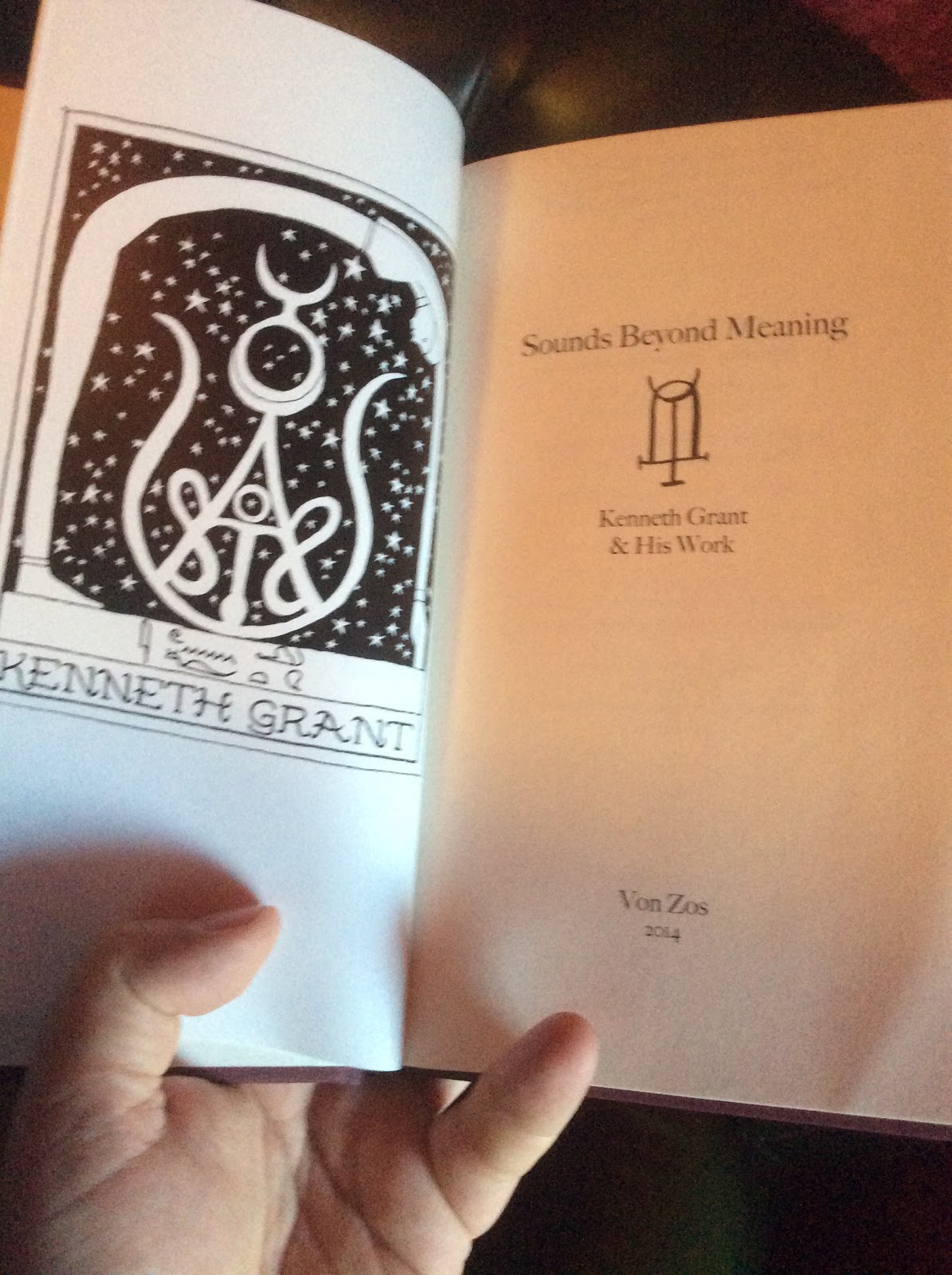
Lovecraftian Thing A Day No.9: Sounds Beyond Meaning


Today I present a recent acquisition: Sounds Beyond Meaning – a talismanic collection of essays in honour of the late Kenneth Grant. For those unfamiliar with the contemporary esoteric oeuvre, Grant was at the forefront of incorporating Lovecraft’s fictive mythology into modern occultural theory and practice - the essays in this volume certainly expound upon that very point (particularly with regard to what Grant referred to as ‘creative occultism’). Indeed, I'll be presenting a series of occult-related Lovecraftiana – and will no doubt end up pontificating at length on this controversial topic – at a later date.

The reason I’m presenting this item is because, at the very moment I'm preparing to post, I'm travelling into central London for the Kenneth Grant Day being held at Treadwells bookshop – at which some of the contributors to Sounds Beyond Meaning will be speaking.

Friday, January 08, 2016

Lovecraftian Thing A Day No.8: Tell Me, Have You Seen the Yellow Sign?


This was a papier mache mask I bought from a craft shop, then modified by adding a version of the Yellow Sign (the one typically used in the Call of Cthulhu roleplaying game) before painting up in a suitable yellowish tone, and adding yellow ribbon as a tie. Unfortunately, the photo doesn't do justice to the actual colouration and painting of the mask which, even if I do say so, is quite good. I ended up wearing this at the Eldritch Ball at NecrononiCon 2015. I had been looking for a set of yellow silk pyjamas to go with it as a 'King in Yellow' costume for the event, but (surprisingly) I wasn't able to find such a garment online. Instead, I wore the mask suited and booted (along with a stylish smoking hat) - there may be images/video out there somewhere of me wearing said apparell at the Eldricth Ball whilst dancing to the Sister's 'This Corrosion'. Good times.

Thursday, January 07, 2016

Lovecraftian Thing A Day No.7: Arkham Artefact


This is an incense holder sculpted in the shape of what looks like one of Brian Lumley’s Cthonians. I purchased it in the early 2000s (if memory serves me well) at Arkham – a now-defunct emporium of the weird located in Brighton, UK. There was a Dave Carson exhibition being held at the shop when I visited – Mr. Carson was himself also present so I had the opportunity of a quick chat; as I  recall, there was also one of his unique shoggoth sculptures on display in the shop window – I wasn't able to afford  it at the time, but managed to acquire it a few years later.

Wednesday, January 06, 2016

Lovecraftian Thing A Day No.6: The Fungi from Yuggoth


Today I present my Lovecraftian desert island disk: the updated and re-released audio recording of the Fungi from Yuggoth sonnet cycle. As a distillation of the thematic essence of Lovecraftian wordsmithery -  including a profound sense of awe and wonder as well as horror  – this approaches being one of my favourite of Lovecraft’s literary efforts. Added to which is the superbly evocative reading of the sonnets to a musical accompaniment which is in turn both eerie and sublime. Mr Jim Moon of the Hypnobobs/Hypnogoria podcast also provides an excellent essay exploring thematic and narrative continuity across the sonnet cycle in the booklet accompanying the CD set. What makes this copy rather unique is that, during a rather fanboyish moment,  I had Jim sign the cover (this occurred last September at the annual shindig organised by the Black Dog podcast – of which Jim is also a co-host).  A version of the essay can also be found at Jim’s blog.

Tuesday, January 05, 2016

Lovecraftian Thing A Day No.5: A Curious Gift


Another art piece for today’s entry. This was gifted to me at the conclusion of a talk I gave on Lovecraft by a mysterious individual dressed, appropriately,  in the style of an 18th Century gentleman –  a true story, by the way. I would like to think, perhaps, that it was the revenant of some sorcerer, resurrected from ‘essential saltes’ found in a lead  urn buried in a hidden corner of some forgotten burying ground...But I digress. This is a really unusual piece painted on a circular wooden board in the style of a religious icon. The cracked effect applied to the paint really adds character.

Monday, January 04, 2016

Lovecraftian Thing A Day No.4: Portrait of Lovecraft


Something a little more personal today. I only managed to scrape a ‘D’ grade on completing my  A level in art. That, however, hasn't stopped me from occasionally committing (and I  use the term in the criminal sense) certain visual doggerel to paper. This pen drawing of H.P.Lovecraft isn't, perhaps, too bad (although I'm sure I ‘borrowed’ the idea of depicting HPL in such a stark chiaroscuro manner from someone else). The frame, at least, is quite nice.

Sunday, January 03, 2016

Lovecaftian Thing A Day No.3: Shoggoth Embryo


Today’s post presents a recent addition to the Ghooric Zone’s collection of Lovecraftian artefacts: a shoggoth embryo procured from Dr Lake of Miskatonic University by Gage  Prentiss of the  Rumtucket Trading Company. A wonderful display piece, it also works well as a paperweight and in a pinch can be used as a blunt instrument for ridding oneself of unwanted guests when those occult experiments inevitably go wrong - remember kids: do not call up that which you cannot put down!

Saturday, January 02, 2016

Lovecraftian Thing A Day No.2: Swan Point Cemetery Map


Yesterday’s post dealt with beginnings; today I turn to the more dour Lovecraftian theme of the fragility of human existence. Thus I present a map of Swan Point Cemetery and the circumstances surrounding its acquisition. The map itself I received from an  officer of the Providence Cemetery Police (yes, that is a thing – or at least it was) during my first visit to Lovecraft’s headstone. That, sadly, occurred on a now notoriously historic date which made my pilgrimage all the more memorable - but for all the wrong reasons: September 11th 2001. The very same morning I had boarded a bus in New York and was fortunate to get out of the city - in the shadow of a vast pillar of smoke, dust and debris - before it was locked down.

The monotony of the bus journey was, rather traumatically, punctuated with (mostly garbled) radio reports regarding the events of that morning. These consisted of sensationalised and apocalyptic claims by almost-gleeful reporters that planes were dropping out of the sky left, right and centre - pretty much a Christian fundamentalist’s wet dream…one woman on the bus was frantically trying to contact her husband, who worked at the World Trade Centre. I'd visited the towers a couple of days earlier, and recall wondering whether the lift attendant I chatted with had survived.

Standing at Lovecraft’s headstone later that day, I was also aware that whilst all this had been going on, strange rites in honour of the Old Ones were being performed a continent away at the edge of the sea near a little village called Dunwich. The shade of Alhazred, having been evoked, was ushering in a truly terrible new aeon of Lovecraftian modernity.

Friday, January 01, 2016

Lovecraftian Thing A Day No.1: First Encounters with Lovecraft - The Encyclopedia of Science Fiction

The start of a new year often brings with it a slew of good intentions. Despite the gradual sloughing-off of humanity presaged by our-almost daily interactions with monstrous cosmic realities, we at the Ghooric Zone retain a penchant for occasionally indulging the remnants of our human foibles - particularly during periods of hominid ritualised festivity. To this end, I have decided to instigate a year-long micro-blogging project: daily, I mean to present a short (a couple of sentences, or a paragraph at most) summary, review or reflection upon an element of my personal collection of Lovecraftiana.

Over the last year or so I have been trying to map/construct something akin to a genealogy of my engagement with weird fiction. Even though Lovecraft did not inaugurate my obsession with the weird, his vision has cast a ponderous shadow over my own life and attitudes - so much so that I have become rather obsessed with recalling the historic when-and-how of my initial encounters with the Old Gent. However, whilst providing a seemingly coherent and continuous narrative of (arguably illusory) personal identity, memory is a fragile thing - and I have never been much of a diarist. To this end I am faced with the onerous task of dredging up, in the face of the hideous obfuscations of time and age, long-buried reminiscences of the mid-to-late 1970s...

With regard to which (and also because we are dealing with beginnings), today's offering is both salient and unusual: in the latter case, because it is not an overtly Lovecraftian tome; in the former because it is (one) of the genealogical threads leading back to Lovecraft's early influence on my interest in weird fiction. Sadly, I've yet to recall exactly when or where I first heard of Lovecraft - although I'm almost certain that I stumbled across allusions to his work prior to reading today's showcased volume. I was certainly familar with Lovecraft prior to my involvement in roleplaying games (which is where, it seems, many Lovecraftians of my generation had their first brush with the Cthulhu mythos). In any case, The Encyclopedia of Science Fiction - edited by Robert Holdstock and published by Cathay Books in the UK in 1978 - was where I first read anything close to an overview of who this Lovecraft fellow was, and what his Cthulhu mythos was all about. Importantly, the book also provided me with the titles of some of Lovecraft's key mythos tales. This in and of itself was paramount - by way of the highly evocative and suggestive nature of said titles - in stimulating a desire to read and find out more about HPL.


Friday, November 13, 2015

Lovecraft, Racism and the World Fantasy Award


A while back I made the decision to no longer participate in Facebook discussions regarding Lovecraft’s racism, due to the fact that they invariably devolve into name-calling flame wars. This week, the awards panel of the World Fantasy Convention announced that the ‘Howie’ – the caricature bust of H.P. Lovecraft sculpted by Gahan Wilson and given to recipients of the World Fantasy Award since 1975 - was being withdrawn after this year’s event. Subsequently there has been a lot of name-calling, tantrums, and general throwing-dummies-out-of-the-pram immaturity over what is, ultimately, a symbolic statement. As I have stated elsewhere regarding the matter, there are much worse things going on in the world at the moment that would provide far better targets for people’s vitriol and anger. Even so, a number of things have emerged around the ‘debate’ – particularly in terms of how the discourse surrounding Lovecraft’s racism is being framed – which I feel a need to comment on.

In the first instance, there is the irony of Howie supporters claiming that it is unfair to judge Lovecraft's racism on the basis of his being a man of his time (MOHT) - whilst condemning the WFA panel for the very same in seeking to reflect modern, inclusive and anti-racist sensibilities. Additionally, I think it worth noting that the MOHT argument forecloses the possibility of making moral evaluations of any kind about anyone or anything - based as it is on a kind of unsophisticated cultural relativism (itself the bugbear of the very same neo-Con attitudes that the disappearance of the Howie appears to be evoking).

Similarly, the MOHT argument problematically treats ideologies as monolithic, culturally homogenous and somehow frozen in particular historic moments in a way that disavows any possibility of social or cultural change. In other words, Lovecraft did not exist within a racialised ideological vacuum. Quite the reverse: anti-racist discourse was evident in the very bodies of knowledge with which Lovecraft regularly engaged: anthropology being a case in point. In this respect, he seemed to pick and choose the anthropological perspectives that best suited his own racialised proclivities, completely ignoring, it seems, the work of keys figure in early 20th Century anthropology - including Franz Boas who, during Lovecraft’s lifetime, presented substantive data contesting the racialised presuppositions of earlier anthropological theory – about which the autodidactic Lovecraft must surely have been aware.

Then there is the odd claim that Lovecraft’s racism is unimportant to understanding his fiction - one which is, frankly, rather risible to anyone who has taken a close look at Lovecraft's major work. Even more so, when some of those who make said claim have also feted Houellebecq for his validation of Lovecraft's work in the literary world - whilst apparently failing to recognise that it is the foundational role of racism to Lovecraft's literary and philosophical production which forms the central thesis of Against the World, Against Life. Similarly Lovecraft’s cosmicism is invoked as his most important literary contribution - but also one that should be treated as separate, discrete and compartmentalised from his racism. This, I think, is also questionable insofar as Lovecraft's cosmicism is acutely tied to his racism by way of the particular cultural aesthetic that Lovecraft evolved out of his cosmic perspective – a topic that I will return to in a later post.

But if anyone was unsure as to the contemporary significance of Lovecraft’s racism, this talk hosted by the British National Party, and effectively lionising Lovecraft as a cultural hero because of his racism (not something I would normally link to), is just one example of how the racialised elements of Lovecraft’s work have contemporary political salience.

Ultimately I can’t help wonder whether apologists for Lovecraft’s racism really understand how racist he could be. His was not some kind of culturally ubiquitous and ‘moderate’ racism (which is not of course to say that even a ‘moderate’ racism is tolerable), but a racism which - as Leeman Kessler points out - at times advocated the legitimacy of ‘extra-legal measures’ for dealing with the ‘race problem’: in other words, Lovecraft appears to have explicitly supported the lynching and murder of African Americans.

Which brings me to a recent tweet by Nnedi Okorafor – herself a recipient of the WFA in Howie form – about being inundated with hate-mail regarding this 2011 blog post. A worrying reflection of the ongoing gamergate controversy where, it seems, anyone who challenges the status quo of white (male) privilege is abused, threatened, and simultaneously labelled as a fanatical ‘social justice warrior’ seeking to impose a minority position of ‘political correctness’ on everyone else.

Indeed, I think that the continued appeal to the perceived evils of 'political correctness' and 'social justice warriors' by detractors of the WFA panel reflects an unsettling - if coded - message from some elements within Lovecraftian fandom signalling an unwillingness to even countenance the possibility of inclusivity. At best such messages perpetuate a utopian myth that today all writers of speculative fiction operate upon the same level playing field, regardless of gender and ethnicity. And this is not just a matter of drawing abstract ideological lines. From a personal perspective - as both an anthropologist and instructor who convenes an academic programme specifically oriented towards widening participation (and also as someone who benefits from white privilege) - I have been witness (but not, of course subject) to the kinds of structural inequalities and forms of structural violence that non-white, non-male, non-middle-class students regularly encounter. Conversely, these are experiences about which many white students are often unaware – simply because those experiences do not constitute a fundamental aspect of their own cultural/class-based/ethnic/gendered lifeworlds. It is not atypical to find that, when addressing issues of race in a class, some students who are the beneficiaries of white privilege ask ‘why are we even talking about racism? We all know it’s wrong!’ The inferential and oft-unspoken corollary of this being ‘because we know it is wrong we can’t be racist.’ Indeed, the obliviousness to white privilege and its consequences by those who benefit from it most is the crux of the matter.

Does this mean that Lovecraft’s literary legacy needs to be redacted? Absolutely not. Even though I support the WFCs decision, this does not amount to advocating a total and absolute Stalinist erasure of Lovecraft’s life and works (as apparently feared by some of the Lovecraftian 'old guard'). I’m certainly not against the use or display of Lovecraft’s image – indeed, as part of my personal collection of Lovecraftian art I own a bust of the Old Gent, as well as many other images and drawings of him:


If the Howie ends up being licensed for sale, I might even buy one. But this is where context is everything. Indeed, there are a couple of other online sources – including this blog post by Ross Lockhart, and this piece by The Atlantic – which more ably address how retiring the Howie is not about vilifying Lovecraft’s literary legacy, but about inclusivity. For my part, I would contend that Lovecraft absolutely is a literary giant – but that his racism is a fundamental part of the literary legacy he has bequeathed to us modern-day Lovecraftians; as such, it needs to be addressed and interrogated. Unequivocally and unapolagetically.

Sunday, November 01, 2015

Return of the Ghooric Zone

After nearly two years away from Whispers from the Ghooric Zone, I've decided once more to ressurect the blog - hopefull this time as an ongoing creative project. Whilst I'll be retaining a focus on all things Lovecraftian and Weird, I may expand the remit of the blog cover other (albeit probably still nominally Lovecraftian-related) topics. Over the past few months I've been building up quite an extensive set of notes regarding possible posts, which should supply ample fuel to my intention of keeping the Ghooric Zone updated minimally on a weekly basis.

There may also be some experimentation where the design of the Ghooric Zone is concerned, so do not adjust your set if you encounter disturbing changes in layout and visual style/presentation over the coming weeks. The Ghooric Zone management take no responsibility for any disoderings of the senses, feelings of utter hopelessness, realisations of insignificance, disquieting suspicions of being a mindless puppet dancing madly in the black and empty void, or other experiences of existential angst subsequent to viewing any changes to the blog.

I digress. Of recent note where things Lovecraftian are concerned, I attended a showing of 'The Shadow Over Innsmouth': a theatrical presentation which was part of the recent London Horror Festival. In previous years, I've been a big supporter of the festival - and, indeed, continue to be so; however, this year's line-up was heavily weighted toward horror-comedy theatre. Whilst I have no objections to this kind of genre mash-up (indeed, I'm a big fan of the Monster Hunters, who have appeared at the festival in previous years), I tend to find the comedic turn a fairly lazy way of presenting horror theatre (not the most accomodating medium to the genre in any case), often playing for cheap laughs by riffing on worn and tired horror tropes. 'Shadow' ended up being the only show I went to see during the festival's run because it was Lovecraft, but also in spite of the fact that it was advertised as a 'darkly comic' adaptation.

Indeed, 'Shadow' was a two person, 45 minute adaptation of Lovecraft's classic tale played almost exclusively for laughs, with lots of funny accents and gurning. All of which, ultimately and unsurprisingly, undermined the power of the original. Whilst there were some valiant attempts to use the comedy for exploring Lovecraft's racism - and the actors did a pretty good turn in making 'Shadow' entertaining as a theatrical experience - it ultimately disappointed due to a complete lack of a sense of mounting dread so central to the key themes of the story; the classic reveal that is pivotal to the original tale also passed almost unnoticed (probably due to the fact that it was constantly being foreshadowed for comic effect).

Whilst I shall certainly be revisiting the London Horror Festival in 2016, here's hoping that it's next iteration will be a little more diverse, with a little less of the comedy and a little more of the horror. In other words: good effort chaps, but must try harder.

On a final (but related) point, it does seem that London has been hitting something of a zenith in terms of horror-themed events of late...a point which I mean to return to in later posts.

Be seeing you.

Thursday, November 21, 2013

De Marigny's Clock: Lovecrafting the Art of Doctor Who (Part 1).

In anticipation of the looming 50th anniversary of Doctor Who, over the next few weeks I will be exploring Lovecraftian influences (both real and speculative) upon the Whoniverse.This isn't the first time something like this has been done, nor will - I'm sure - it be the last. Indeed, only last week a thread appeared on the H.P. Lovecraft Historical Society's Facebook page discussing the very same topic. But not one to be put off by casual accusations of plagiarism, I shall proceed nonetheless. As an aside, I will use this opportunity to shill the imminent launch of yet another blog, Peeking From Behind the Sofa, which will document my attempts at systematically watching the entirety of classic Who...again, nothing new here, as this has been done many times over: for an excellent podcast attempting the same (whilst drunk), check out Drunken Time Travel. Say hello from me to Dalek Steve whilst your over there.

Matters of originality aside, Doctor Who played a key role in traumatically effecting my obsession with the weird. At the age of about five, I went through that classic rite of passage common to many children of a certain age living amongst the dreary desolation that was 1970s Britain: of being scared witless and hiding behing the sofa (or settees as we called them then) whilst watching that classic horror tv series, Doctor Who. Yes, for me at the time Doctor Who was a horror series. Unsurprising given that my earliest memory of the programme was during Jon Pertwee's tenure, when the Doctor and Jo Grant  were rowing through a sludge of fucking green luminescent slime (which would kill you horribly if you touched it) in a mine cart whilst being threatened by giant fucking maggots!  Not only did this traumatise my five year old self, but laid a firm foundation upon which was built the gateway into a strange new world of the horrible and the fantastic. Happy days!

But I get ahead of myself. Going back to the origins of Who, there is not much to be said by way of Lovecraftian themes or influences in the First and Second Doctor eras (William Hartnell and Patrick Troughton). As a horribly mutated and tentacular species inimical to all life, the Daleks probably come closest to being Lovecraftian: 'Exterminate!!!' being possibly the defining epithet of a Lovecrafitian (or perhaps more properly Ligottian) universe. The Hartnell era also firmly established a conceptual link to Lovecraft with regard to what he considered to be a driving of the aesthetics of the weird - namely the 'adventurous expectancy' that arises from the imagined suspension of the natural law allowing one to participate in infinite voyagings across time and space. In this respect, I think we disregard Lovecraft'a emphasis on awe and wonder at our peril: the perception of him being first and foremost a writer of horror (rather than of the weird) has become far too overdetermined. In a twist on Peter Cannon's The Lovecraft Chronicles, one could almost imagine in an alternative timeline an older Lovecraft playing the First Doctor (quite possibly wearing his father's old suit):


The First Doctor?

As other's have noted, Brian Lumley's later Titus Crow stories seem to be a thinly-veiled Derlethian spin on Doctor Who, with Crow jetting about time and space in de Marigny's clock (hence the title of this series and, if I recall aright, also bigger on the inside). Indeed, I have a recollection of the Master's TARDIS during the Fifth Doctor's era taking the form of a grandfather clock...


With the second Doctor, what we have by way of Lovecraftian stylings has largely been retconned by later Who (particularly in the New Adventures novels of the 1990s - more on those later), such that the Great Intelligence has been identified in some Whovian sources Yog Sothoth. It remains unclear as to whether this is Whovian 'canon' or not, although intriguingly the most recent series featuring Eleventh Doctor Matt Smith has the Great Intelligence as, quite literally, an Eater of Souls. This is, of course, one of Yog-Sothoth's sobriquet's,  introduced in the Illuminatus Trilogy in the cosmic entity consumes and entraps the life-force of human beings like flies in amber for all eternity. This is also the version of Yog Sothoth that that Charles Stross works with in his chilling short story A Colder War. However, there is much speculation here - although there is one instance during the reboot of Who when 'the Great Old Ones' are actually mentioned...
As noted above, the entry of Pertwee's Third Doctor marked (at least for me) a tonal shift towards the horrific, which would later reach its apex in the classic Robert Holmes stories of the Fourth Doctor's era. Though ostensibly no explicit Lovecraftian references here, we do have the tentacular Axons from The Claws of Axos, and of course the Silurians and the Sea Devils, who come closest to an overt nod of the head to Lovecraftian themes: ancient, prehuman races - akin to the serpent men of Valusia and the Deep Ones - returning to wipe out humanity.
Even so, both of these stories were tempered by shifting societal attitudes during the late/post-hippy era as the Doctor sought to broker a peace between these ancient races and humanity - although in both cases ineffectively in the face of the blunt militarism of the British government and UNIT. As with the Great Intelligence, the Nestene intelligence of the classic Auton stories has also been retconned as the Great Old One Shub Niggurath in the New Adventure novels. In addition, at least one rpg iteration of Doctor Who has also tried to link the Sea Devils to Lovecraft's Dagon. Another story echoing notably Lovecraftian themes is, of course, The Daemons, where ancient supernatural evil turns out to be the intrusion of extraterrestrial forces. The Three Doctors also introduced the protoplasmic Gell Guards...
as well as Omega: a figure from Gallifrey's ancient history - a history which, in the Doctor's later incarnations, would be revealed as replete with intriguing Lovecraftian possibilities (the forbidden knowledge of the Black Scrolls of Rassilon...).

Wednesday, November 20, 2013

Recent Acquisition - The Eye of Azathoth

Just a quick update on a recent acquisition: The Eye of Azathoth - a Lovecraftian ouija board with Nightgaunt planchette, made by Jason McKittrick of Cryptocurium.


This was available in limited numbers for just one week - I've always wanted a mythos-themed Ouija board, so when I saw this I snapped it up. My planchette is numbered 10 of 13, so it looks like this was produced in very limited numbers.


And the planchette glows in the dark:


Nice.


The board itself is printed on a vinyl sheet - apparently this is because it is less likely to get scratched when using the planchette. If I'm honest, I would have really liked it as a mounted board, but this is still a remarkably unusual piece.

Sunday, November 10, 2013

Bong - 'Idle Days on the Yann'

Readers of the previous post may recall my enthusiasm for a paper on Dunsanian drone metal given at the Weird conference earlier in the week. To give full credit, this was by Owen Coggins of the Open University, the full title of the piece being 'Awakening Mana-Yood-Sushai: Lord Dunsany's Weird Fiction (and other Sacred Scriptures) in Drone Metal Music'. In the interim, I've downloaded several of the musical works mentioned by Owen, notably the albums Bethmoora, Mana-Yood-Sushai and Idle Days on the Yann all by Bong. Rather than offer a detailed overview of these, I'll settle for a very brief and impressionistic capsule review of Idle Days on the Yann, purely because this is a concept album based on the eponymous tale by Dunsany, and which happens to be one of my favourite (and certainly most read) of the Dunsany canon.


In terms of musical style, Idle Days on the Yann certainly elicits a strong Middle-Eastern - one might even say orientalist -flavour (especially the first track), mixed with Tibetan-influenced dronings and inferences of raga rock, that sit very well with Dunsany's literary exoticism. Where I perhaps part company with Bong is with regard to mood. The two album tracks (each over 20 minutes in length) that make up Yann do seem very pendulous and somewhat doom-laden as far as atmospherics are concerned, which for me doesn't quite arouse the wistful, melancholic - and occasionally sardonic - mood of Dunsany's original tale. In brief, whilst Bong's take here is very effective at evoking the overall feel of Dunsanian weirdness, it didn't quite succeed in conjuring the ambience or disposition of the original tale. As an album, Idle Days on the Yann is a great piece of weird rock mysticism - something I will definitely be listening to when ensconced in my sanctum sanctorum...


...whilst pouring through some horror-filled tome of forbidden lore. But in the latter regard, it is a work better suited as background to, say, a pilgrimage to the awful, squat black monasteries of Leng than as soundscape to a drowsily dream-like excursion along the banks of the River Yann.

Idle Days on the Yann by Bong can be downloaded for the low price of four English pounds here.

Much of Dunsany's work - which I now understand to be out of copyright - can be downloaded freely in multiple formats here.

Saturday, November 09, 2013

The Weird: Fugitive Fictions/Hybrid Genres


Academia. Grrrr! I'll say no more than that, other than note that recent experiences had been such that I really was not looking forward to attending The Weird conference (hosted on by Birkbeck college's Institute of English Studies at Senate House in London). As the day of the conference approached, this turned into simple indifference - even though I was down to present a paper (on 'Weird Occultures and Lovecraftian Modernity') during the first session of panels. My initial intention - influenced by the likelihood that I would have to go into work later that afternoon to sort out some frustrating HR stuff (an eventuality which, thankfully, did not come to pass) -  was to get in, give the paper, and get out as soon as possible.

Fortunately, my rather skewed expectations that this was going to be yet another typically dry and self-congratulatory academic gathering were swiftly undermined. And, indeed, my supposition that it would be a lit crit dominated event were also misplaced. Whilst lit crit was understandably well represented, the organizers had made a real effort to reflect the 'hybrid genres' part of the conference title by inviting speakers to debate manifestations of 'the weird' in varied media contexts including music, film, gaming, as well as in occultism and with regard to its impact on the wider culture. Of note were some really interesting pieces on landscape and space in weird literature, the weirding of time in M.R. James and Nigel Kneale, the weird in computer gaming, and a very favourable piece on Dunsany-influenced drone-metal - a genre I was previously unaware of. In any case, the paper in question has now encouraged me to investigate the musical stylings of popular beat-combo Bong:


Nice.

It was also a great opportunity to meet with friends old and new: Steve Dempsey (GB Steve over at yog-sothoth.com) who furnished me with a personally signed copy of the Shotguns v. Cthulhu anthology (cheers Steve); Gwilym Games of the Friends of Arthur Machen (who gave a cracking talk on Machen and witchcraft), noted fortean chap Mark Pilkington, and the inestimable Mr. Steve Wilson, veteran of the London pagan moot scene. Also great to finally meet Christopher Josiffe, who also presented a fascinating paper on reading Kenneth Grant as fiction (we were on the same panel), enthusing me to revisit Grant's work in the near future.

I was very happy with my talk (one of the best I've given for a while, I feel), although it did suffer from an overabundance of academese (something I tend to be very critical of in other people's work - see below!) amidst presentations which were for the most part clear, concise and more notable for their engaging theoretical perspectives than for political grandstanding or academic obscurantism. Even so, I think I did manage to explain my position fairly clearly and (for once) think I did a pretty fair job at fielding questions - notably an insightful one from Benjamin Noys (whose own presentation on Savoy Press' notorious Lord Horror I unfortunately missed).

Roger Luckhurst also gave a fascinating keynote on the significance of the corridor in weird fiction (much more interesting than it sounds, although tiredness due to insomnia the night before didn't quite permit me to take in all the details of his argument). As far as I could tell, S.T. Joshi was absent from Luckhurst's talk...Joshi's keynote opening keynote speech, whilst interesting, didn't really offer much new by way of what we've come to expect, and was largely a reiteration of chapters on Poe and Lovecraft from his Unutterable Horror. As a fellow attendee noted, Joshi's talk was very descriptive, and offered very little in the way of analysis. Indeed, this has been my issue with Joshi in recent years who, unlike Lovecraft scholars such as Burleson and Price, seems to ignore completely contemporary bodies of social, cultural and literary theory with regard to his subject matter, and instead remains hidebound to an almost 19th century (and rather puritanical) model of scholarship and literary criticism (as well as what makes for 'good' literature). In this respect, his now infamous criticisms of Luckhurst do seem rather trite and outdated. That said, Joshi's contribution to keeping Lovecraft's memory and fiction alive is immense, so I still retain the utmost respect for him (especially with regard to his editorial and biographical work). And I think I've said before, Joshi always seems much more personable in the flesh than does his rather irascible on-line presence.

Even though I was flagging for the better part of the day (due to the aforementioned insomnia), I ended up supping a reviving  pint or three with Christopher and Mark Pilkington (whose gave a great presentation earlier in the day on Sidney Sime, and author of one of my all-time favourite ufological books, Mirage Men) at the end of the day as we discussed Gef the talking mongoose (the topic of a book Christopher is currently writing), John Keel, the state of current ufology, Lovecraft and Kenneth Grant, and other matters no doubt of deep esoteric import. On the matter of Sime, the Dover edition of Dunsany's Gods, Men and Ghosts with illustrations by Sime has pride of place amongst my Dunsany collection.


The upside of all this is that the conference has re-enthused my interest in academia and research  -  this event seemed, very much, to be a 'my kind of people' thing - particularly in its inclusiveness. The downside being that this is leading me to further question my current positioning within the field of anthropology: a discipline which I don't think I really understand anymore; within which I feel rather marginalised; and one in which I feel increasingly constrained by the apparent institutionalised requirements of the discipline to frame any kind of writing or research in a profoundly politicised manner (and the content of my paper for this conference was certainly shaped by this). For some academics (especially social scientists), a statement of this kind will be anathema and no doubt seem like a betrayal of all that academia stands for. But sometimes I just want to listen to someone telling me about the religious dimensions of Dunsanian drone metal without this having to relate to some worthy poststructuralist critique of capitalism.

Be seeing you.

Friday, November 01, 2013

I Am Providence available on Kindle

Direct from David Haden's Tentaclii blog, news that S.T. Joshi's I Am Providence is now available for Kindle for a ridiculously low sum. Whilst I have the two volume hardback edition, I've not managed to finish it as I tend to do a fair amount of reading on the move, and have been fearful of damaging my hardcopies, so this is a most welcome development. Lovecraft's collected essays have been available in electronic format for some time, so here's hoping that Hippocampus Press also add the various volumes of Lovecraft's letters they've published to their electronic stable.

Thursday, October 31, 2013

Return of the Ghooric Zone!

Given that it is Hallowe'en, this seems like an appropriate moment to resurrect - or should I say reanimate - Whispers from the Ghooric Zone. Indeed, this has been my plan for sometime and is, in part, a reactive response to a number of significant changes that have impacted upon my personal life over the past few years. Needless to say, being a typical Brit, this is not the kind of thing I'm prone to talk about in public (in fact, I'm likely to unfriend you on Facebook if you start bawling about how hard life is treating you...). In any case, this has led to a re-assessment of my 'creative' output (or lack thereof) over the past few years, a failing I mean to rectify. So, alongside this blog, I anticipate launching two additional blogs in the coming weeks, dedicated to a couple of fun personal projects. Ghooric Zone will continue to cover all things weird and Lovecraftian, hopefully maintaining regular updates of at least one substantive post per week. For now, I draw your attention to the upcoming relaunch of Jeremy Dyson (of The League of Gentlemen fame) and Andy Nyman's Ghost Stories, probably the best piece of theatrical horror I have ever seen (thrice - once during its original run at the Hammersmith Lyric, and twice during its West End run). It will be moving to the Arts Theatre in Leicester Square, London, from February next year - it looks like tickets are already for sale. In the meantime, check out Dyson's The Haunted Book, which I thought was excellent (although beware that this has a very non-traditional ending). There's a very creepy piece of viral marketing for the book (filmed at Leeds Central Library - one of my stamping grounds of old) here. Finally, I will be attending (and giving a paper - on weird occultures and 'Lovecraftiuan modernity') the conference at the Institute of English Studies on 'The Weird' next Friday. That's it for now, and happy Hallowe'en.