Near the crown of Horsingdon Hill there stands an ancient and withered tree, known locally as ‘The Hanging Tree’. Tradition has it that during the time of the witch hunts, the tree was used as a place of execution for those poor and marginalised women falsely convicted of the crime of maleficarum - and whose revenants are said to haunt the site to this day.
Thursday, January 05, 2023
Spectral Static: The Horsingdon Transmissions 2023, No. 5 - The Tree at the Edge of the World
Wednesday, January 04, 2023
Spectral Static: The Horsingdon Transmissions 2023, No.4: Strange Enclosures
Sturdy new iron railing has recently been installed around the small Boreham family plot in the cemetery of St. Osmund’s Church on Southcote Lane.
The reasons for the railing’s installation remain unclear, and no explanation has been forthcoming from either Horsingdon Borough Council or the episcopate body which has jurisdiction over the diocese. There certainly haven’t been any reported desecrations in the old burying ground for decades.
However, those intimately acquainted with the witchlore of the region have noted the apotropaic character of the material used in the railing’s construction, and the significance of this with regard to long-standing rumours of the Boreham family’s participation in the Horsingdon and Burn Hill covens. This has lead to speculation that, rather than providing an impediment to ingress to the parts of the churchyard it seemingly protects, the iron railing instead acts as ward against something within the enclosed area which seeks trespass into our world…
Tuesday, January 03, 2023
Spectral Static: The Horsingdon Transmissions 2023, No.3: Bats in the Belfry?
It is rumoured that the steeples and belfries of the some of the old and disused churches scattered throughout the parish of Horsingdon are haunted by things far older and more terrible than bats.
Monday, January 02, 2023
Spectral Static: The Horsingdon Transmissions 2023, No.2: Unmarked Graves
Even in the best-kept and most estimable of Horsingdon’s boneyards, you are likely to encounter some unkempt, rewilded corner where a few graves lie overgrown and untended. Curiously, with a small number of these plots one may discover that, on closer inspection, their cracked and crooked headstones have surfaces worn clean, such that they possess no inscription or other visible signifier as to the precise identity of whose resting place they designate. Curiouser still is the fact that such erasures are not the always the product of time and the elements: for some of these gravestones, it is clear that the names of the departed have been intentionally effaced.
Sunday, January 01, 2023
Spectral Static: The Horsingdon Transmissions 2023, No.1: The Whispering Dead
An abandoned transmitter array overlooks a graveyard located in a lonely corner of Marsh End in the semi-rural district of Trentford. Constructed as part of a secretive Ministry project in the early 1960s, the array was decommissioned towards the end of the Cold War; however, it is rumoured amongst some of the older residents of Marsh End that the array remains operational: that if one tunes a radio to a certain frequency, one may discern the trace of faint, spectral voices; that if one listens carefully, those voices will disclose in whispered, awestruck tones hints of the vast, unspeakable things and forbidden secrets which await revelation in those nameless spaces which lie beyond the threshold of the grave.
Friday, January 10, 2020
A Weird Gazetteer: Daily Excursions into the Lovecaftian Imaginary: Roerich and Leng
Tuesday, January 07, 2020
A Weird Gazeteer: Daily Excursions into the Lovecraftian Imaginary 7: Dunwich and Rendlesham Redux
Monday, January 06, 2020
A Weird Gazetteer: Daily Excursions into the Lovecraftian Imaginary 6: Clapham Wood
Clapham Wood is a small patch of hillside woodland in West Sussex which, along with Chanctonbry Ring and Rackham Hill, forms part of Sussex’s ‘Devil’s Triangle’; in light of which it has a reputation as being a focal point of ufo sightings, is allegedly a site at which black magic ritual are regularly practiced, and where unearthly presences have been encountered - including one account of a twelve-foot high shadowy entity which left in its wake inhuman, four-toed footprints. A number of disappearances of dogs and other domestic animals have also been reported in the vicinity of Clapham Wood, and the bodies of four people have been discovered there since the 1970s - at least one of whom was murdered. Apparently there is also a crater at the centre of the Wood (known as ‘The Pit’), and supposedly caused by either a meteorite or a ufo landing, depending on who you listen to.
Toyne Newton and Charles Walker, in their 1987 book The Demonic Connection, claim that Clapham Wood has regularly been used as a ritual site (sometimes involving human sacrifice) by a Satanic cult known as The Friends of Hekate (an entity who is, of course, evoked in Lovecraft’s The Horror of Red Hook). This claim has been further explored by Andrew Collins in the book which popularised the activity of psychic questing, The Black Alchemist.
If all of the above were not Lovecraftian enough, I am also aware of one occultist who attempted to contact the Fungi from a Yuggoth through a Cthulhuvian occult dream-working at Clapham Wood - a working which, I have reason to believe, was relatively successful; I was also informed by one individual involved in the strange affair of The Black Alchemist that some of the psychic questing activities which occured in and around the area of Clapham Wood May have involved uncovering ancient sites and contacting alien entities believed to be related to the Cthulhu Mythos...
Sunday, January 05, 2020
A Weird Gazetteer: Daily Excursions into the Lovecraftian Imaginary 5: Rendlesham, Lovecraftian Ufology, and Weird Fiction
The emergence and popularisation of forms of occult belief and practice inspired by the pop-cultural pulp-fictions of Lovecraft and others - not to mention the seemingly-pervasive presence of Cthulhu memes within various popular cultural media platforms - being obvious examples of the kind of incubation Partridge is talking about. Indeed, some of the earliest examples of this occultural production originate with Lovecraft himself, by way of his use of verisimilitude: citing, for instance, the very real Dr John Dee as a translator of the entirely fictive Necronomicon as part of a process of world building - collectively supported by the cross-referencing of entities such as Cthulhu and Nyarlathotep amongst other Weird Tales authors - which contributed to some early readers of Lovecraft’s work believing that the Cthulhu mythos constituted an extant, ‘real world’ mythology.
Conversely, a number of contemporary authors of weird fiction have begun to incorporate some of the locales and figures cited as part of the emergent mythology of Lovecraft-inflected occult ufology I have been exploring in previous posts. For example, Jack Parson’s occult influence upon the development of NASA’s attempts to penetrate into the endless darkness between the stars is a cornerstone of Christopher Slatsky’s novella of cosmic horror, Palladium at Night (which is being reprinted in Slatsky’s forthcoming collection, The Immeasurable Corpse of Nature). Parsons also appears as a character in Douglas Wynne’s novel of the Cthulhu Mythos, Smoke and Dagger. Rendlesham also gets a chilling mention (by way of Margaret Thatcher) in the epilogue to Neil Spring’s The Watchers; whilst inspired primarily by Nick Redfern’s sensationalist conspiratorial take on an element of the Ultraterrestrial hypothesis, Spring’s novel nominally touches upon at least one element of the Cthulhu Mythos.
Whilst I don’t think Rendlesham receives a mention in its various supplements, the Delta Green setting for the Call of Cthulhu rpg also incorporates contemporary ufo mythologies into a modern reframing of the Cthulhu Mythos. As another example of occulture, elements from the Delta Green series of books have made their way into the narratives of a number of online conspiracy theorists (Douglas Dietrich comes to mind). In any case, I anticipate we will see more of the same as the new decade unfolds.
Saturday, January 04, 2020
A Weird Gazetteer: Daily Excursions into the Lovecraftian Imaginary 4 - Alfred Bender, Lovecraftian UFOlogy, and ‘The Whisperer in Darkness
Published in 1956, Gray Barker’s They Knew Too Much About Flying Saucers documents the author’s friendship with Alfred Bender, who claimed to have stumbled upon the truth about flying saucers; however, before he had the chance to make this knowledge public, Bender was apparently visited by three strange men dressed in black - making Barker’s book the first to introduce Men-in-Black (MIBs) into the burdgeoning lore of ufology. The men (who, with diabolic aplomb, always left behind them a faint smell of sulphur) initially claimed to be representatives of the US government. Bender was apparently left terrified by the encounter, and remained silent on the matter of UFOs until 1962, when he revealed what he claimed was the horrifying truth behind the phenomenon in his own book, Flying Saucers and the Three Men. There he states that the MIB’s are in fact aliens in disguise, having established bases on Earth (usually in remote locations) with the intention of siphoning-off a chemical from sea water for some unknown purpose - an activity not so far removed from Lovecraft’s Fungi from Yuggoth. Bender also claims that the MIB’s visited him numerous times, on one occasion - and here the story takes a truly Lovecraftian turn - spiriting him off via some sort of teleportation or hyperdimensional travel to their central base of operations buried deep beneath the Antarctic ice.
There, one of the MiB’s reveal its true form: according to Bender a ‘hideous monster, more horrifying than any I have ever seen depicted in the work of science fiction or fantasy artists’ (p.81). This latter admission of familiarity with the sci-fi genre may be an important admission with regard to some of the formative influences upon this important episode in the history of ufology, and a point I shall return to. Needless to say, in true Lovecraftian fashion the alien is so horrific as to be indescribable. Or in any case, Bender apparently lacks the vocabulary to do so, as there is never any attempt at description made in his book.
Perhaps more interesting is the fact, in marked counterpoint to the utopian and millenarian messages offered to other ufo contactees of the period, that the MIBs reveal to Bender a nihilistic cosmology that seems to have jumped right out of the pages of Lovecraft. The monstrous aliens tell him that the physical universe is the product of a ‘vast glowing body so immense one cannot calculate its density. It is the creator of us all, and more families of planets are constantly being formed and thrown off into orbits’ (p.79). Later in Flying Saucers and the Three Men, this cosmology is elaborated in more detail:
‘there is a large main body from which all the planets and their suns are formed by means of being cast off into the vast void we call space. This main body seems to grow in size and never diminishes, despite the fact that it discards new bodies constantly. It is so hot a mass you could not go near it, even in terms of billions of your light years. All the bodies cast off are hot burning balls of fire, and as they reach the cooler parts of space they explode and form smaller bodies that circle them. These smaller bodies become planets as they cool off, but the cooling-off period consumes many, many years. We have sent out spacecraft to explore the regions beyond the circling bodies where there is an area that is deep black and in which you are unable to see anything…We have lost many of our exploring craft who went too far into the deep black and never returned’ (p.98-99)
This rather dark, melodramatic - and suitably cosmic - vision of the cosmos (which resonates somewhat with Lovecraft’s image of Azathoth as a ‘bling, idiot god’) is reified in the aliens' comments on religious matters: they reveal that there is neither god nor life-after-death, and that Jesus was a fraud. Morally ambivalent entities themselves - akin to Lovecraft’s Old Ones who are ‘beyond good and evil’ - the aliens are quite open about the fact that they have abducted, experimented upon, and even killed humans to protect their interests; they also implant Bender with a small metal disk (foreshadowing a key element of later abduction narratives) and make dire warnings not to reveal what they have shown him until they have left the planet. Almost as an afterthought, the MIBs tell Bender that the Dero of Richard Shaver are real (and, in fact, the source of most human accounts of supernatural beings).
Indeed, the themes of abduction, experimentation and implantation by sinister forces which Bender apparently experienced owe a massive debt to Shaver’s imagined underground worlds book (and in turn inspired the tales of alien underground bases which gained renewed vigour in the 1980s and 1990s when American ufology took a decidedly disturbing turn). Elements of Bender’s tale also seem strikingly akin to themes found in Lovecraft - even moreso given the disparity of Bender’s paranoid vision with the more optimistic provisions supplied from within the contactee movement. A likely source of inspiration for Bender's tale would be The Whisperer in Darkness which seems to have set the template not only for the ‘abductee’ phenomenon that swept ufology in the 1980s – 1990s, but also introduces MiB-like figures in the strangely hypnotic human agents of the Fungi from Yuggoth. Similar to Bender’s narrative, and central to Lovecraft’s Whisperer, are the awe-inspiring but nihilistic revelations of cosmic magnitude revealed to the narrator - albeit only hinted at for the reader - by the character of Akeley (or an alien who is impersonating Akeley).
Sadly, there is no hard evidence to support the claim that Bender was drawing upon Lovecraft in the construction of his and Gray Barker’s conspiratorial narrative. However, I noted earlier Bender’s implied familiarity with genre fiction: Bender does, in fact, admit to a fascination with the literature of the weird and supernatural, mentioning Shelley, Stoker and Poe as favourites. Barker and others also note that Bender was also fascinated by occult subjects, and I seem to recall mention of Bender using occult techniques as a means of contacting aliens (but at the moment I haven’t managed to track down references in support of this). Whilst there is no mention of Lovecraft per se in either Barker’s or Bender’s books, it appears that Bender was familiar with the later pulps such as Palmer’s Amazing Stories, and it seems plausible that he may have had a passing familiarity with some of Lovecraft’s tales. If this is the case, Bender's work may represent an additional link in the chain between Lovecraft and contemporary ufology.
Friday, January 03, 2020
A Weird Gazetteer: Daily Excursions into the Lovecaftian Imaginary 3 - Rendlesham, Occult Ufology, and 'The Whisperer in Darkness'
Thursday, January 02, 2020
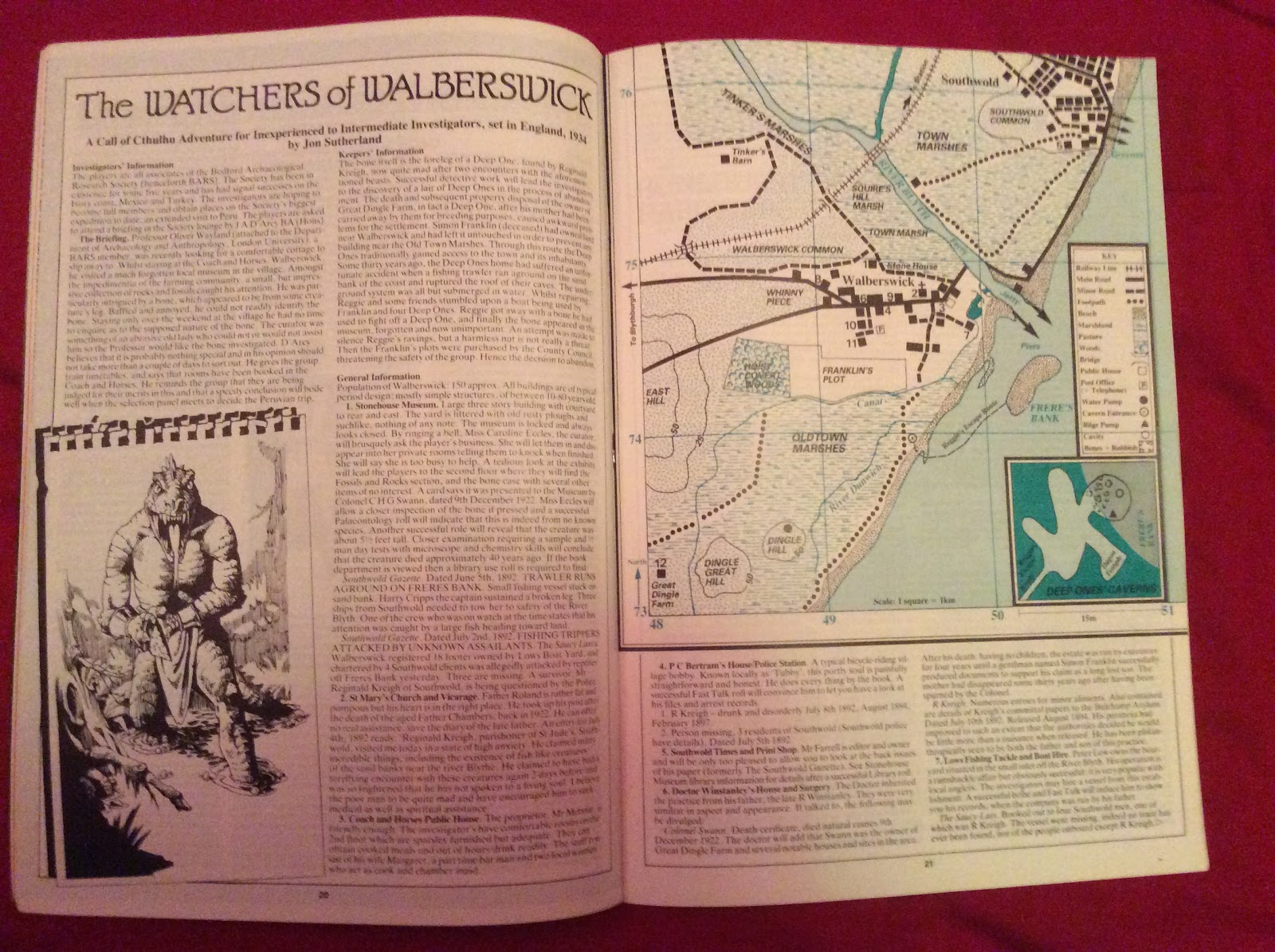
A Weird Gazetteer: Daily Excursions into the Lovecraftian Imaginary 2: The Watchers of Walberswick
The Watchers of Walberswick is something of a classic scenario (with what might be considered sandbox elements) for the Call of Cthulhu role-playing game, first appearing in issue 50 of White Dwarf in February 1984.
I mention it here as something of an aside to the promised post (additional ruminations on Lovecraft and the Rendlesham Forest Incident) not only because the issue of White Dwarf in question appeared in my post this morning, but because, coincidentally, The Watchers of Walberswick also has a tangential bearing on yesterday’s entry: the scenario is set in the real-world locale of Walberswick on the Suffolk coast, which happens to be only a few miles from Dunwich, and about twenty miles from Rendlesham Forest (Dunwich River also flows past Dunwich to Walberswick, where it connects with the River Blyth before entering the North Sea).
Whilst I’m sure that this has no significant bearing on any Lovecraft-Rendlesham connection, it nonetheless speaks to how the area in question (no doubt because of the Dunwich connection) has accrued other (albeit fictive) Lovecraftian associations.
In any case, tomorrow I will return to an examination of how recent historical developments in the field of ufology has led to Lovecraft being linked to Rendlesham via the recent BBC adaptation of The Whisperer in Darkness.
Wednesday, January 01, 2020
A Weird Gazetteer: Daily Excursions into the Lovecraftian Imaginary 1 - Rendlesham
On Saturday 28th December 2019, I attended Minimum Labyrinth’s Rendlesham: a unique one day event leading participants on a guided tour of Rendlesham Forest in Suffolk: the location of a series of apparently UFO-related incidents which occured during December 1980, when members of the US military stationed at the RAF Woodbridge base at the edge of the Forest supposedly encountered a craft of unknown origin. The case has since been described as ‘Britain’s Roswell’. Coincidentally, in the weeks running up to the Minimum Labyrinth event, BBC Radio released a podcast series which retold Lovecraft’s The Whisperer in Darkness in a kind of mockumentary/investigative reportage format, updating it to the modern day, relocating the tale from the hills of Vermont to Suffolk’s Rendlesham Forest, and making the events of December 1980 a central feature of the story’s narrative.
Rendlesham Forest itself is not far from Orford Ness where, according to local folklore, a Deep One-like humanoid was once captured; the Forest is also relatively close to Dunwich - all of which are referenced in the BBC adaptation of The Whisperer in Darkness. Indeed, the whole area - which I first visited in the mid-2000s - really does feel like the UK’s real-life version of Lovecraft country (Arkham, Dunwich, Innsmouth Kingsport, etc), replete with all kinds of curious folklore and lots of Lovecraftian-sounding place names (Ipswich, Harwich, Dedham, etc.). I am also aware of at least one occult group which undertook a Lovecraftian ritual in or around Dunwich in the early 2000s.
In any case, in later entries I mean to suggest that, when viewed in relation to recent histories of esoteric/paranormal/ufological cultures, the linking of Lovecraft to Rendlesham which occurs in the BBCs version of The Whisperer in Darkness represents an organic development of the occultural co-option of Lovecraftian tropes which has been widely occurring within esoteric milieux since the early 1970s. I also predict that it is a development which will likely escape its fictive roots to gain purchase within online conspiracy communities, to eventually become part of the evolving narrative of the Rendlesham Forest Incident - as well as contributing more generally to the emergent Lovecraftian properties of modern UFO mythologies.
Monday, November 18, 2019
Malign Frequencies - Further Transmissions from Horsingdon, No.151: Kodak Factory, Harlow.
Sunday, October 20, 2019
Malign Frequencies - Further Transmissions from Horsingdon, No.130: Ancient Arcana
In Horsingdon, what passes as a simple graffiti tag may be something else entirely: an undecipherable glyph drawn from a body of incalculably ancient, inhuman - and unspeakably terrible - arcana.
Saturday, October 19, 2019
Malign Frequencies - Further Transmissions from Horsingdon, No.129: The Face in the Widow
Malign Frequencies - Further Transmissions from Horsingdon, No.128: The Ghost Tree
The Ghost Tree, in Boreham Park. It is said that, if you dance widdershins round the tree at midnight on All Hallow’s Eve, you will see a ghost.
It is also said that the phantom you will most likely encounter is your own: the spectre of your eventual ending, beckoning to you from the moment of your future demise.
Malign Frequencies - Further Transmissions from Horsingdon, No.127: Project TRIDENT
Three windowless towers rise from industrial installation fenced in by iron palisades topped with barbed wire - an installation which some have averred as having ties to a long-rumoured Ministry experiment known only as Project TRIDENT, reputedly dealing with the cryptolinguistics and decipherment of signals from an extraterrestrial source.
Whatever the case, on rare occasions a curious, sonorous sound can be heard emanating from somewhere close the the vicinity of these strange, windowless towers.
Malign Frequencies - Further Transmissions from Horsingdon, No.126: Behind the Static
Malign Frequencies - Further Transmissions from Horsingdon, No.125: Hedgerows
In Horsingdon, it is quite possible to discover the most remarkable - and terrible - things hidden behind the hedgerows.