I've had a couple of requests (Hi Terje!) concerning an update about the Al Hazred Legacy (my proposed indie roleplaying game). Fear not, the game is still in development. However, the bad news is that a first draft is unlikely to see the light of day for a while yet. This is mainly due to generally busy-ness, and the fact that I have a number of other more pressing projects to focus on at present. This is compounded by the fact that, although I have the opportunity to play boardgames with some lovely folk over in South East London every so often, I'm not currently part of a roleplaying group (and that's not likely to change in the near future), which means playtesting the damn thing could be somewhere way down the line.
However, I may as well use this as a plug for Contested Ground's Cold City indie rpg, with which I currently enamoured with (think Cold War monster hunting in 1950's Berlin with a good dose of Lovecraft and Charlie Stross thrown in to boot).
Thursday, June 21, 2007


Tuesday, June 19, 2007
Back Soon
Whispers from the Ghooric Zone has been on hiatus for the last few weeks (a consequence of our temporary entrapment in exam-marking hell) but be assured we will be back soon. At least it gives Mr. H.P. Alberelli more time to respond to my previous post...
Sunday, May 27, 2007
Lovecraft & the Awful Redux
H.P. Albarelli Jr. has contacted Ghooric Zone central on the matter of 'the Awful' (his comments can be found attached to the earlier post on this topic), having taken issue with my thoughts on his article. Mr. Albarelli informs me that he has no reason for emphasising a link between Lovecraft and Vermont, and that he does not even care for Lovecraft's writings. 'Fair enough' we at Ghooric Zone central say. But why then make such an issue of Lovecraft's alleged involvement in the case? And why claim that said cryptid had an important influence on Lovecraft's writing career? However, questions such as these simply sidetrack the main issue: where is the evidence to support claims about Lovecraft's interest in the case? And, indeed, for his supposed secret visit 1925 to Vermont? Given that Mr. Albarelli's article emphasises the important influence of 'the Awful' on Lovecraft's writing, it would also be helpful if full and proper referencing/sourcing of Lovecraft's alleged quotes on the matter could be provided. The following paragraph being the most problematic on this account:
"When H.P. Lovecraft returned to southern Vermont from Richford he told friends he was convinced that the Richford locals he had interviewed were "not in the least mistaken about what they had witnessed." Lovecraft later wrote, "The Awful became ample sustenance for my imagination" and "over time the creature became the basis for many of my own fictional inventions."
I'm trying not to be too smug or trite about this, because if Mr. Albarelli's claims can be supported they would constitute a major breakthrough in contemporary Lovecraftian scholarship, indicating a significant new source of Lovecraft's ideas, and necessitating a re-evaluation of Lovecraft's well-documented scepticism of things Fortean. I await Mr. Albarelli's response with trepidation.
"When H.P. Lovecraft returned to southern Vermont from Richford he told friends he was convinced that the Richford locals he had interviewed were "not in the least mistaken about what they had witnessed." Lovecraft later wrote, "The Awful became ample sustenance for my imagination" and "over time the creature became the basis for many of my own fictional inventions."
I'm trying not to be too smug or trite about this, because if Mr. Albarelli's claims can be supported they would constitute a major breakthrough in contemporary Lovecraftian scholarship, indicating a significant new source of Lovecraft's ideas, and necessitating a re-evaluation of Lovecraft's well-documented scepticism of things Fortean. I await Mr. Albarelli's response with trepidation.
Saturday, May 26, 2007
The Conspiracy Against the Human Race
My, how the last couple of weeks have flown by! It only seems a few days ago since my last post...
In any case, Thomas Ligotti has posted his first major work of philosophical non-fiction The Conspiracy Against the Human Race at Thomas Ligotti Online. The essay is currently available to view for free on-line or as a pdf download for members of the site, but is likely to be removed once Durtro publish the essay in hardcopy.
This seems like a good move, especially to someone like myself who has become increasingly frustrated at how difficult it has become to procure Ligotti's recent works (most of which seems to have been published in expensive limited editions): as a major literary exponent of the weird, Ligotti certainly deserves wider recognition.
In any case, Thomas Ligotti has posted his first major work of philosophical non-fiction The Conspiracy Against the Human Race at Thomas Ligotti Online. The essay is currently available to view for free on-line or as a pdf download for members of the site, but is likely to be removed once Durtro publish the essay in hardcopy.
This seems like a good move, especially to someone like myself who has become increasingly frustrated at how difficult it has become to procure Ligotti's recent works (most of which seems to have been published in expensive limited editions): as a major literary exponent of the weird, Ligotti certainly deserves wider recognition.
Friday, May 11, 2007
Lovecraft & 'The Awful'
The June issue of the Fortean Times (no. 223 in the UK) contains an article on p.10 drawn from a Vermont local newspaper, the County Courier. Said article reports on the return of a flying cryptid known locally as 'the Awful', and the author makes various claims that Lovecraft secretly visited Vermont in 1925 to investigate this monstrous entity. In fact, the article in its entirety can be found on-line here, where additional claims are made about the pervasive influence of 'the Awful' on Lovecraft's writing. Unsurprisingly no references are supplied for any of the supposed quotes, although the final quote of Lovecraft's cited in the comlete article comes from his short travelogue 'Vermont - A First Impression' (an account of his documented 1927 trip to Vermont and published in March 1928 - see Lovecraft's Collected Essays vol. 4 published by Hippocampus Press, 2005). Otherwise, there is no evidence (at least of which I am aware) to support the claim that Lovecraft went to Vermont in 1925. Of course, the trip being secret, we can presume that evidence is either non-existent or difficult to come by (which begs the question of exactly how the article's author uncovered these 'facts'!).
In any case, said author was probably banking on the association between Lovecraft and Vermont via 'The Whisperer in Darkness', working Lovecraft into the tale about 'the Awful' retrospectively. In any case it seems that what we are actually dealing with here is a case of a fiction being used authoritatively to support another fiction.
On a more conspiratorial note (those of us at Ghooric Zone central being partial to the occasional dissemination of conspiracies) the on-line context in which the article appears makes me wonder if 'the Awful' - sounding a little bit too Lovecraftian, perhaps, to constitute an piece of established local folklore - has been purposely manufactured to legitimise a particular reading of Lovecraft as occult/Fortean apologist?
What fascinates here is the cultural salience of Lovecraft's very name (especially, it seems, within Fortean and occultural circles) and the presumption that simply adding 'Lovecraft' to the mix implicitly validates the claims of the writer deploying it.
In any case, said author was probably banking on the association between Lovecraft and Vermont via 'The Whisperer in Darkness', working Lovecraft into the tale about 'the Awful' retrospectively. In any case it seems that what we are actually dealing with here is a case of a fiction being used authoritatively to support another fiction.
On a more conspiratorial note (those of us at Ghooric Zone central being partial to the occasional dissemination of conspiracies) the on-line context in which the article appears makes me wonder if 'the Awful' - sounding a little bit too Lovecraftian, perhaps, to constitute an piece of established local folklore - has been purposely manufactured to legitimise a particular reading of Lovecraft as occult/Fortean apologist?
What fascinates here is the cultural salience of Lovecraft's very name (especially, it seems, within Fortean and occultural circles) and the presumption that simply adding 'Lovecraft' to the mix implicitly validates the claims of the writer deploying it.
Thursday, May 10, 2007
Lovecraft & the Occult MP3 files available for download
The mp3 files of my 'Lovecraft and the Occult' talks at Treadwells Bookshop are now available for download at yog-sothoth.com.
A massive thank you to Paul of Cthulhu for offering to host the files, and for maintaining what is without doubt the premier (and Ennie award-winning) site for the Call of Cthulhu roleplaying community.
Also thanks to Dan Harms, John Gonce and Jason Colavito whose works I plundered for the second and third instalments of the talks.
A massive thank you to Paul of Cthulhu for offering to host the files, and for maintaining what is without doubt the premier (and Ennie award-winning) site for the Call of Cthulhu roleplaying community.
Also thanks to Dan Harms, John Gonce and Jason Colavito whose works I plundered for the second and third instalments of the talks.
Monday, May 07, 2007
Patricia MacCormack at Treadwell's
Patricia MacCormack - of whom the fungal hive-mind here at Ghooric Zone central can claim a brief acquaintance - will be speaking at Treadwell's tomorrow night, and rumour has it that her talk will include more than a little Lovecraft:
08 May 2007 (Tuesday)
Enfolding Magic
The Demon of the Female
Dr Patricia MacCormack (Anglia Ruskin University)
£5
7.15 for 7.30 pm start
'The reconfiguration of flesh underpins contemporary Continental philosophers Deleuze and Guattari. Tonight, Patricia MacCormack takes this idea, and enfoldment of surface, as a starting point on a journey through inflecting flesh of female genitalia, sexuality, magic, horror, daemonic alliance, and the idea of becoming-woman. The female genitalia, she posits, is a monster, all the more monstrous for being so tempting, for evoking the fascination of ambivalence. For all the ways it transgresses dominant phallic paradigms it is both prohibited and revolt-ing (in both senses of the word). It is, above all, an assemblage of folds, organs, elements, textures, tastes and involutions with its disciples. It is a daemon. Who dares and invokes this daemon, then? Tonight's speaker is senior lecturer of Continental Philosophy at Anglia Ruskin University; she works on philosophical issues in contemporary magic, including chaos magick, feminism, occult culture and HP Lovecraft.'
Those of us here able to extract ourselves from the tendrils of the rhizomic Ghooric zone collective (currently residing at an undisclosed location below the Plateau of Leng) will endeavour to be present tomorrow. For those of you not fortunate enough to be in the locale on the evening, we would point you in the direction of the following online essay on Lovecraft, Lefanu and Leibniz which Patricia contributed to the Irish Journal of Gothic and Horror Studies.
08 May 2007 (Tuesday)
Enfolding Magic
The Demon of the Female
Dr Patricia MacCormack (Anglia Ruskin University)
£5
7.15 for 7.30 pm start
'The reconfiguration of flesh underpins contemporary Continental philosophers Deleuze and Guattari. Tonight, Patricia MacCormack takes this idea, and enfoldment of surface, as a starting point on a journey through inflecting flesh of female genitalia, sexuality, magic, horror, daemonic alliance, and the idea of becoming-woman. The female genitalia, she posits, is a monster, all the more monstrous for being so tempting, for evoking the fascination of ambivalence. For all the ways it transgresses dominant phallic paradigms it is both prohibited and revolt-ing (in both senses of the word). It is, above all, an assemblage of folds, organs, elements, textures, tastes and involutions with its disciples. It is a daemon. Who dares and invokes this daemon, then? Tonight's speaker is senior lecturer of Continental Philosophy at Anglia Ruskin University; she works on philosophical issues in contemporary magic, including chaos magick, feminism, occult culture and HP Lovecraft.'
Those of us here able to extract ourselves from the tendrils of the rhizomic Ghooric zone collective (currently residing at an undisclosed location below the Plateau of Leng) will endeavour to be present tomorrow. For those of you not fortunate enough to be in the locale on the evening, we would point you in the direction of the following online essay on Lovecraft, Lefanu and Leibniz which Patricia contributed to the Irish Journal of Gothic and Horror Studies.
Sunday, May 06, 2007
Lovecraft Scholars
I've just added a link to the Lovecraft Scholars discussion group at yahoo which I co-moderate with James Kneale and Bill Redwood. The group is a diverse and sometimes lively forum for discussing things Lovecraftian from a broadly 'scholarly' (though not necessarily 'academic') point of view. Admittedly, though, I haven't been much of a contributer myself in recent months due to general busy-ness. Whispers on the Lovecraftian esoteric grapevine also intimate that additional visual evidence of yours truly engaging in 'anthropological fieldwork' may be forthcoming on YouTube...
Saturday, May 05, 2007
Weird Realism Re-visited
Just a note to the effect that Mark Fisher has posted some astute observations and reflections on the the notion of the 'weird' as well as commenting on the recent Weird Realism conference at his k-punk blog.
As Mark notes, the conference remained largely focused on its stated aim (although admittedly my paper strayed somewhat from this), but did not satisfactorily resolve the 'problem' of 'the weird' in definitional terms (not that such a thing should be expected from a one-day conference!). China Mieville summed up the problematics of the weird when he made a statement along the lines of 'I can't define the weird but I know it when I see it', which leaves me wondering whether an attempt to conceptually 'fix' the weird might ultimately fall into the trap of overdetermining the concept (thus divesting it of its power)? This is why, in my mind, occultural appropriations and explorations of Lovecraft's universe often fail: they tend to frame Lovecraft's Old Ones - a la Derleth - within the safe and meaningful intersubjectivity of an anthropocentric worldview, or otherwise try to fix Lovecraft's cosmicism within the familiarity of established esoteric structures of thought(attempts by Kenneth Grant and Alan Moore to subsume Lovecraft's creations into the kaballah for example). However, as Mark notes, this is the very reason why many of Lovecraft's tales are written from a first-person perspective: the very 'weirdness' of the 'weird' is produced by intrusions 'from beyond' upon the normative expectations and contraints produced by an all-too human subjectivity. The problem with the occultural use of Lovecraft - and perhaps a consequence of subjecting the weird to too strenuous an analysis - is it so often takes the weird and makes it familiar. Even when Lovecraft does this (describing the Elder Things of Antarctica as 'men') he then presents us with a kind of recursive horror(to paraphrase Fritz Leiber, Lovecraft intimates that there is something that even the monsters are afraid of).
Also, I wonder if it is useful to delineate a clear conceptual boundary between the 'weird' and 'the fantastic': Hodgson's 'Night Land' seems to straddle both the weird and the fantastic; the same could also be said of M. John Harrison's 'Viriconium' tales and indeed Mieville's Bas-Lag novels. There are even (albeit brief) intimations of intrusions of 'outsideness' in Tolkien, although I certainly wouldn't consider his writing to be of 'the weird'.
I guess I'm wondering here at the embodied, affective and experiential dimensions of reading Lovecraft that are perhaps not easily fixed or reducible (and that coming from a reductionist materialist!)...
None of this is, of course, meant to suggest that Lovecraft should not be theorised - as modernity's key 'mythographer' he more than any other modern writer is in desparate need of a sustained theoretical investigation.
As Mark notes, the conference remained largely focused on its stated aim (although admittedly my paper strayed somewhat from this), but did not satisfactorily resolve the 'problem' of 'the weird' in definitional terms (not that such a thing should be expected from a one-day conference!). China Mieville summed up the problematics of the weird when he made a statement along the lines of 'I can't define the weird but I know it when I see it', which leaves me wondering whether an attempt to conceptually 'fix' the weird might ultimately fall into the trap of overdetermining the concept (thus divesting it of its power)? This is why, in my mind, occultural appropriations and explorations of Lovecraft's universe often fail: they tend to frame Lovecraft's Old Ones - a la Derleth - within the safe and meaningful intersubjectivity of an anthropocentric worldview, or otherwise try to fix Lovecraft's cosmicism within the familiarity of established esoteric structures of thought(attempts by Kenneth Grant and Alan Moore to subsume Lovecraft's creations into the kaballah for example). However, as Mark notes, this is the very reason why many of Lovecraft's tales are written from a first-person perspective: the very 'weirdness' of the 'weird' is produced by intrusions 'from beyond' upon the normative expectations and contraints produced by an all-too human subjectivity. The problem with the occultural use of Lovecraft - and perhaps a consequence of subjecting the weird to too strenuous an analysis - is it so often takes the weird and makes it familiar. Even when Lovecraft does this (describing the Elder Things of Antarctica as 'men') he then presents us with a kind of recursive horror(to paraphrase Fritz Leiber, Lovecraft intimates that there is something that even the monsters are afraid of).
Also, I wonder if it is useful to delineate a clear conceptual boundary between the 'weird' and 'the fantastic': Hodgson's 'Night Land' seems to straddle both the weird and the fantastic; the same could also be said of M. John Harrison's 'Viriconium' tales and indeed Mieville's Bas-Lag novels. There are even (albeit brief) intimations of intrusions of 'outsideness' in Tolkien, although I certainly wouldn't consider his writing to be of 'the weird'.
I guess I'm wondering here at the embodied, affective and experiential dimensions of reading Lovecraft that are perhaps not easily fixed or reducible (and that coming from a reductionist materialist!)...
None of this is, of course, meant to suggest that Lovecraft should not be theorised - as modernity's key 'mythographer' he more than any other modern writer is in desparate need of a sustained theoretical investigation.
Sunday, April 29, 2007
Post-Weird Realism Tentacularity

Last Thursday's 'Weird Realism' conference was a blast, despite the emphasis being on philosophical interpretations of Lovecraft's work (not being a philosopher - to be frank, Continental philosophy gives me the willies - some of the more gritty discussion was a bit hard to follow).
Sadly, my paper appeared to cause some confusion, I guess as a result of failing to communicate my ideas clearly. In any case some of the participants seemed to think that I was saying the opposite to what I was actually trying to express (that occultural appropriations of Lovecraft's fiction does tend to drift towards a kind of 'McDonaldisation' and celebration of consumerism). One point I also failed to emphasise, though, was that such appropriations can be considered 'revolutionary' in the way that science-fiction and fantasy genres more generally are replete with a 'revolutionary potential': namely in facilitating a re-envisioning and re-pereception of the world. In any case, it was a fruitful experience, forcing me to re-evaluate some of my notions about Lovecraft's work. Also fantastic to see, at last, Lovecraft being taken seriously within academia. I'm not aware that any other conference has been solely dedicated to Lovecraft, making this a first.
Highlights of the day were Benjamin Noys presentation of 'The Shadow out of Time' and (trying not to be too much of a fanboy here) China Mieville's discussion of the post-WWI explosion of the 'tentacular' (which is also explored in his introduction to 'At the Mountains of Madness'). I also felt that Mieville's notion that Lovecraft's entities - far from being 'unnameable' - are drawn with an explicit and often overdetermined precision was spot on.
Cogratulations to all who made it such a fascinating event - special thanks go out to Mark Fisher for organising it
Monday, April 23, 2007
Weird Realism Paper
Here's the paper I've written for this week's Weird Realism: Lovecraft and Theory conference at Goldsmiths College. Please note that I haven't yet revised the bibliography, which still contains a number of sources not currently cited in the text of the essay. There are a small number of footnotes that go with the essay, but, to be honest, I can't be bothered incorporating them at the moment!
‘All dimensions dissolve in the absolute’:
Magick, modernity and the horror of indetermination in
Through the Gates of the Silver Key
Justin Woodman (2007)

Introduction
'The time has come when the normal revolt against time, space & matter must assume a form not overtly incompatible with what is known of reality - when it must be gratified by images forming supplements rather than contradictions of the visible & measurable universe. And what, if not a form of non-supernatural cosmic art, is to pacify this sense of revolt - as well as gratify the cognate sense of curiousity?’ (Lovecraft 1971: 295-296)
S.T. Joshi concludes that this statement - made whilst Lovecraft was writing his ‘demythologised’ (Price 1990) masterpiece ‘At the Mountains of Madness’ - ‘may be the most important theoretical utterance Lovecraft ever made’ (Joshi 1996: 489). What Joshi (quite rightly) treats as significant here is Lovecraft’s ‘Copernican’ (Leiber 1980) materialist reframing and modernist re-imagining of the literature of the weird. Equally important, though, is the fact that Lovecraft’s ‘most important…utterance’ retains a ‘gnostic’ sensibility at its theoretical core, albeit locating this within what Erik Davis has famously described as ‘a twisted materialism in which scientific progress returns us to the atavistic abyss, and hard-nosed research revives the factual basis of forgotten and discarded myths’ (Davis 1995: 5). Indeed, despite his varied and well-documented iterations of unbelief (and uncompromisingly negative views of the occult), a gnostic sensibility remained central to Lovecraft’s personal aesthetics:
'Time, space and natural law hold…suggestions of intolerable bondage, and I can form no picture of emotional satisfaction which does not involve their defeat - especially the defeat of time, so that one may merge oneself with the whole historic stream and be wholly emancipated from the transient and the ephemeral' (Lovecraft 1971: 220)
The conceptual tension which Lovecraft attempts to resolve in his later weird writings - between myth and modernity, between a romantic gnosticism and materialism - footnotes wider Western social and cultural tensions: those emergent from the rationalising and disenchanting project of Enlightenment modernity which reactively birthed the romantic, anti-materialistic and overtly gnostic magical revival of the 19th century. In its late 20th and early 21st century manifestations this revival does, in fact, owe a huge debt to Lovecraft’s fictions (see for example Lachman 2001; Woodman 2004; Colavito 2005), a point I explore later in this paper. No doubt Lovecraft would stand aghast at these contemporary romantic and anti-rationalist occultural appropriations of his literary vision were he alive today; even so, if Colin Wilson is to be believed Lovecraft himself waged a ‘war with rationality’ (Wilson 1976: 1), palpable in his own gnostic romanticism and in his ‘Cthulhu mythos’ tales which uncompromisingly delineate irruptions of chaotic, non-rational forces deeply antagonistic to the quotidian and to modernity’s instrumental rationality.
Lovecraft may, indeed, have waged a war against rationality but he framed this revolt in terms of an ‘adventurous expectancy’ (Lovecraft 1971: 100), enumerating the symbolic power of the topographies of the everyday to generate (at least for the aesthete) a ‘sense of expansion, freedom, adventure, power, expectancy, symmetry, drama, beauty-absorbtion, surprise and cosmic-wonder’ (Lovecraft 1971: 124) . As China Mieville points out, Lovecraft is ‘a kind of bad-son heir to a religious visionary tradition, an ecstatic tradition, which…locates the holy in the everyday’ (Mieville 2005, xii-xiii). In which case, Lovecraft’s ‘gnosticism’ is one that is profoundly embedded in a particular perception of the materiality of things. In this respect his war against rationality did not necessitate a denial of the real, nor a complete dissolution of the self in some transcendent absolute. This latter point is conspicuous in the ‘horror of indetermination’(Bauman 1991: 56) expressed by Lovecraft in ‘Through the Gates of the Silver Key’ (and, indeed, many of his tales). In fact, for Lovecraft the ‘revolt against time space and matter’ was one that remained deeply grounded in two authoritative principles of Enlightenment modernity: that of the autonomous self, and the claim of science to a privileged objectivity. Thus Lovecraft writes:
‘my wish for freedom is not so much a wish to put all terrestrial things behind me & plunge forever into abysses beyond light, matter & energy. That, indeed, would mean annihilation as a personality rather that liberation. My wish is best defined as a wish for infinite visioning & voyaging power, yet without loss of the familiar background that gives all things significance’ (Lovecraft 1971: 214).
Crucially, though, the horror of indetermination given expression in Lovecraft’s key literary creations (Azathoth, Yog Sothoth, shoggoths, the hybrid Deep Ones et al) is as much a consequence of that very same rationalist and materialist epistemology to which Lovecraft subscribed. This is, in fact, explicitly recognised in the opening paragraphs of ‘The Call of Cthulhu’:
‘The sciences, each straining in its own direction, have hitherto harmed us little; but some day the piecing together of dissociated knowledge will open up such terrifying vistas of reality, and of our frightful position therein, that we shall either go mad from the revelation or flee from the deadly light into the peace and safety of a new dark age’ (Lovecraft 1926: 125).
This paper seeks to make sense of the cultural popularity and salience of Lovecraft’s life and work: a salience, I claim, which rests on Lovecraft’s ability to capture and encapsulate modernity’s own ambivalence toward chaos and the indeterminate as alluring, desirable and liberating on the one hand, and polluting and horrifying on the other.
That ‘progressive’ capitalistic modernity produces chaos - a notion implicit in the works of social theorists like Weber and Marx - paradoxically enunciates the possibility of disrupting the hegemonic aspects of that selfsame modernity. While Lovecraft’s view of chaos was, generally, reactionary, Benjamin Noys (2007) suggests that Lovecraft offers cautionary ruminations on chaos via the ‘horror of indetermination’. In ‘Through the Gates of the Silver Key’, for example, Lovecraft’s fictional alter-ego Randolph Carter seeks to step across the threshold of order and structure in search of ‘the untrammeled land of his dreams and the gulfs where all dimensions dissolve in the absolute’, only to discover a site of abject horror and detestable hybridity. Through an exploration of these ambivalences which surround chaos and uncertainty - in this instance, as articulated in Lovecraftian occultural enactments which take their cue from ‘Through the Gates of the Silver Key’ - I consider that, though undoubtedly replete with revolutionary potential, engagement with the uncertain is neither exclusively exterior to consumerist modernity nor antithetical to it.
Lovecraft, Magick, and Modernity
Parts of this article draw loosely upon anthropological fieldwork conducted amongst the community of Chaos magicians in London between 1997 - 2001. Chaos magick appeared in the United Kingdom during the late 1970’s under the aegis of Peter Carroll and Ray Sherwin (Sutcliffe 1995: 127; Hawkins 1996: 31-34) and forms part of a wider occult subculture. Chaos magick is significant here in constituting one of the major strands of contemporary occultures which has explicitly engaged in sustained magical enactments of Lovecraft’s ‘Cthulhu mythos’.
The focal point of Chaos magick is the attainment of gnosis through altered states of consciousness, and is the means of awakening practitioners to an unmediated experience of “Chaos”: a term denoting the inchoate, indeterministic and amoral life-force which forms the ontological foundation of the cosmos and the microcosmic self. Gnosis also enables Chaos magicians to engage the “magical will”: the single-pointed focusing of practitioners’ intentionality and imagination upon the nascent potentia of Chaos, in doing so transforming both the substance and their perception of the world.
A popular maxim amongst Chaos magicians - who view themselves as ‘postmodern’ magicians advocating a radical epistemological and moral relativism - is ‘Nothing is True, Everything is Permitted’. In the absence of absolutes, practitioners posit the necessity of adopting a Nietzschean attitude of self-affirmation and self-creation. Through gnosis, Chaos magicians thus attempt to bypass the conditioning and conventions imposed upon the individual by culture, society, and ideology. This is sometimes referred to as illumination - the experience of Chaos, unmediated by socially-constructed and sublimated beliefs, expectations and desires. Despite these libertarian tendencies the Chaos magicians I worked with often displayed an ambivalence towards authoritative epistemological discourses: whilst rejecting “positivist” science, they embraced popular exegeses of quantum theory and the science of ‘chaos’ or non-linear dynamics. Chaos magick is thus conceptualized as a quasi-scientific project:
‘a kind of scientific anti-science...Chaos Magic attempts to show that not only does magic fit comfortably within the interstices of science but that the higher reaches of scientific theory and empiricism actually demand that magic exists.’ (Carroll n.d.a.: 1).
Such claims promote and legitimise the view that the apparent structure and order of observable reality is founded upon indeterministic, acausal, and non-teleological bases. Crucially it also underpins the Chaoist claim that reality is no more than the product of perception and belief. Given such concerns, it is unsurprising that Lovecraft’s pseudo-mythology has formed a focal point of Chaos magical practice.
Merged with the therapeutics of spirit possession, Chaos magick also aim to make visible the ‘demons’ of the psyche. Such demons are conceived of as socially-inculcated and unconscious fears, desires and habits which shape practitioners’ personae, and are often personified and imbued with a degree of agency by Chaos magicians. Practitioners also believe that they can negotiate with or master these demons; the demonic thus form the locus of the project of self-transformation, another key aspect of Chaoist praxis.
With regard to the central themes of this paper, it is worth noting that recent analyses of Western occultures have tended to position them as sites of resistance to the rationalising and alienating effects of modern consumer capitalism. However, another body of Marxian-influenced theory concerned with the ‘modernity’ of postcolonial African witchcraft beliefs (Comaroff & Comaroff et al 1993; Geschiere 1997; Clough & Mitchell 2001 et al; Moore & Sanders 2001 et al) offers an alternative to polarising tendencies (especially in the field of anthropology) which have equated witchcraft and magic with the ‘traditional’, the ‘romantic’ and the ‘non-rational’. Rather, witchcraft is seen to represent an inherently modern idiom by which the impersonal, mystifying and occluded transnational economic interventions which have increasingly come to shape actors’ local experience are made visible, and by which new inequalities of power - as well as the allure of commodities and a market economy - become comprehensible within indigenous systems of thought.
In the face of this, the ‘anti-modernity’ of Chaos magick is rendered problematic; for Chaos magicians, the demonic is a highly ambivalent category (both morally and ontologically) insofar as it represents a source of both alienation and (within the context of possession practices) creativity and resistance. As such, encounters with the ‘demonic’ aspects of the self - often rendered in terms of Lovecraft’s Cthulhu mythos comparable with Randolph Carter’s self-identification with Yog Sothoth in ‘Through the Gates of the Silver Key - enable practitioners to construct contextual and contingent narratives of selfhood, narratives that are commensurable with the uncertainties and anxieties inherent in the ‘condition’ of modernity. As Paul Heelas (1996: 3) argues, ‘New Age’ spirituality (in which he includes neo-pagan and magical subcultures) challenges certain aspects of modernity, but it also incorporates many of modernity’s core values and assumptions: typically those of responsibility and self-reliance (Heelas 1996: 168) which form part of the utilitarian and individualistic “enterprising self” of capitalist modernity (Heelas 1991b: 74, 78). Similarly Susan Greenwood (2000: 10) suggests that neo-paganism also forms part of the individualistic discourses of modernity in searching for an experience of an “authentic” or core self.
Importantly, the modernity of Chaos magick is discernable in its praxis, which not only incorporates the ‘modern’ discourses of self-discipline and self-surveillance (Foucault 1977), but also re-formulates the supernatural in a manner commensurable with the psychologistic discourses of modernity. In common with ‘New Age’ movements, the supernatural is thus seen in terms of ‘atavistic’ irruptions the unconscious forces, or imaginally-realised manifestations of the occluded self which can be ‘worked’ with as part of a psychotherapeutic project. As a result, the broadly libertarian and therapeutic goals of Chaos magick also constitute a set of discursive practices attuned to the social, economic and ideological requirements of modernity, and to its characteristic ontological and moral uncertainties (Lash & Friedman 1992, Giddens 1991, Beck 1992, Rose 1990). Thus the Chaos magician Phil Hine not only states that ‘being a ‘good’ magician...is being effective and adaptive in as many areas of one’s life as possible’ (Hine 1995: 48), but also claims that Chaos magick has emerged ‘out of the twists of contemporary culture, a reflection and reification of the current social landscape’ (Hine 1995: 175 -176). Subsequently, the practices of Chaos magick - in reifying the ‘current social landscape’ - encourage participation in the consumption of neatly-packaged experiences of exotic otherness, drawn from the profusion of signs, images and ‘lifestyle options’ characteristic of consumer capitalism.
Associations of the occult with ‘tradition’ also fail to acknowledge the ‘modernity’ that is fundamental to the central project of contemporary occultures: namely, the pursuit of an synthesis of science, religion and magic that is instrumental, rationalising and demystifying (Ben-Yehuda 1989: 254, 1985: 104; Truzzi 1972: 413; see also: Truzzi 1974b). This is, in fact, precisely the space that Lovecraft inhabits within the structure of contemporary occultural thought (and precisely the reason for recognizing his wider cultural salience): the ‘Cthulhu mythos’ has garnered wide appeal because it does, indeed, offer a rationalized and technologised reframing of the supernatural. Thus does the atheist and materialist Lovecraft thus sit comfortably alongside such iconic figures of the contemporary occulture as Helena Blavatsky and Aleister Crowley: all three, in their varied ways, sought to reconcile ancient myth with scientific modernity (Harms 2004: 39).
‘Becoming-Monstrous’: Occultural Enactments of Lovecraftian Chaos
Importantly, the popular and occultural appeal of Lovecraft’s work lies not just in his demythologising of the supernatural, but (as suggested in the introduction) his ability to reveal science as a source of profound awe and strangeness: the denouement of ‘At the Mountains of Madness’ suggests even greater cosmic horrors lurking just beyond the horizon of the Elder Things’ advanced scientific knowledge; as Robert Price (1992) himself has admitted, there is an ambivalence about the supernatural in Lovecraft’s work: even the most ‘secular’ of his alien races are given to abandoned ecstatic worship of monstrous cosmic abnormalities.
Perhaps this is why there appears a strange but brief disjuncture in Lovecraft’s literary output during 1933: the merging of science and sorcery that is a key thematic component of his other work of this time slips momentarily with the writing of ‘Through the Gates of the Silver Key’. Originally penned by E. Hoffman Price under the title ‘The Lord of Illusion’ (see Price 1997), the tale was later re-written almost in its entirety by Lovecraft. Situated initially within Lovecraft’s burgeoning ‘weird materialism’, the tale forms an adjunct to his earlier literary explorations of hyperspace in ‘The Dreams in the Witch House’ (1932) wherein archaic New England witchcraft is revealed as an alien science. This is problematised, however, by the recalcitrant quasi-mystical ruminations which permeate ‘Through the Gates of the Silver Key’ and which at first glance seem far removed from Lovecraft’s materialism. Even though the overtly occult and Theosophical sentiments of the story can be attributed to Price, the themes and substance of the finished collaboration appear to be Lovecraft’s. Those themes are, indeed, consistent with Lovecraft’s peculiar form of ‘gnostic materialism’: how an ‘ecstatic’ perception of things does not mystify everyday reality in terms of a ‘higher’ transcendent reality, but ‘reveals’ the meaning of the everyday as a matter of one’s perspectival positioning and perception within the indeterminate multiplicity of the real . As Randolph Carter discovers in ‘Through the Gates of the Silver Key’:
‘The world of men and of the gods of men is merely an infinitesimal phase of an infinitesimal thing - the three-dimensional phase of that small wholeness reached by the First Gate, where 'Umr at-Tawil dictates dreams to the Ancient Ones. Though men hail it as reality, and brand thoughts of its many-dimensioned original as unreality, it is in truth the very opposite. That which we call substance and reality is shadow and illusion, and that which we call shadow and illusion is substance and reality…so do the local aspects of an unchanged and endless reality seem to change with the cosmic angle of regarding. To this variety of angles of consciousness the feeble beings of the inner worlds are slaves, since with rare exceptions they can not learn to control them. Only a few students of forbidden things have gained inklings of this control, and have thereby conquered time and change. But the entities outside the Gates command all angles, and view the myriad parts of the cosmos in terms of fragmentary change-involving perspective, or of the changeless totality beyond perspective, in accordance with their will.’ (Lovecraft 2005: 284 - 284, my italics).
Though Lovecraft and Price here equate substance with illusion, I would suggest that Lovecraft’s own gnostic sensibility attempts to recover the marvelous within the everyday. What is illusory here, it seems, is not reality itself; rather, it is the localized perceptions of that reality which lack substance. Contemporary occultures such as Chaos magick have, indeed, directly co-opted this core element of Lovecraft’s fiction and deployed it as a kind of ‘social diagnostics’ by which imaginal delvings into Lovecraftian hyperspace via trance and other altered states of consciousness are treated by practitioners as generating liberating perspectival shifts (Woodman 2004). As I suggest below, for Chaos magicians a renewed perception of the real-as-monstrous strives also to recover the marvelous in the everyday from the alienating conditions of consumer capitalism. Importantly these perspectival reorientations require, as Randolph Carter realizes in ‘Through the Gates of the Silver Key’, a Nietzschean transition from a human to a ‘monstrous’ post-human condition:
‘Damnation, he reflected, is but a word bandied about by those whose blindness leads them to condemn all who can see, even with a single eye. He wondered at the vast conceit of those who had babbled of the malignant Ancient Ones, as if They could pause from their everlasting dreams to wreak a wrath on mankind. As well, he thought, might a mammoth pause to visit frantic vengeance on an angleworm. Now the whole assemblage on the vaguely hexagonal pillars was greeting him with a gesture of those oddly carven sceptres and radiating a message which he understood: 'We salute you, Most Ancient One, and you, Randolph Carter, whose daring has made you one of us.'’ (Lovecraft 2005: 275- 276; my italics).
Here Lovecraft prefigures what I have identified elsewhere (Woodman 2004) as a central characteristic of ‘Lovecraftian magick’: that of Chaos magicians’ self-identification with the monstrous and alien ‘other’. In this sense Lovecraft’s ‘Old Ones’ are rendered not as alien outsiders but as an alien immanence and a kind of Deleuzian ‘becoming-alien’ which precipitates a post-human metamorphosis. In the words of Anton LaVey, Lovecraft’s Old Ones are ‘spectres of a future human mentality’(LaVey 1972: 178). Invariably occultural enactments of Lovecraft’s fictive universe rest on a ‘becoming alien’ through the kinds of hybridity commonly encountered in Lovecraft’s tales and, indeed, evident in the Carter-Zkauba hybrid and Carter’s immersion within a multiplicity of identities in ‘Through the Gates of the Silver Key’. Correspondingly, practitioners of Chaos magick seek to experientially embrace atavistic chaos whose multiplicity is invited to take habitation of otherwise stable bodies in ritual acts of spirit possession. This was described by one Chaos magician as the process of
'waking up the Great Old Ones that lie sleeping...the primeval consciousness of the universe which has been lying dormant in humanity but is now slowly waking up...becoming the monsters ourselves.'
Similarly, another practitioner informed me that seeking possession by the Old Ones was a method of ‘trying to approach the unthinkable through the monstrous’. It was these acts of ‘becoming-monstrous’ which precipitated perspectival disruptions of ‘normative consciousness’.
Becoming alien, monstrous, and hybrid marks a transgression, a culturally forbidden stepping across the thresholds and boundaries into the hinterlands of structure, precipitating heterogeneity, amorphousness and anomaly. Martin Bridgestock (1989) thus argues that horror fiction is fundamentally characterised by a concern with the marginal, the anomalous and the interstitial: it is the ‘horror of indetermination’, the incursion of chaos, the ‘blasphemous’ violation of established cultural codes and categories which evokes horror. Inhabiting ‘the borderland between mental categories', Lovecraft’s entities threaten ‘our entire system of thought and, by implication, the society which generates it’ (Bridgestock 1989: 115). As with Lovecraft’s own protagonists, these disruptions provoke corresponding perspectival disruptions of ‘normative consciousness’, causing many of the Chaos magicians I worked with to experience physical and psychological distress. Yet as James Kneale notes ‘while we might inevitably locate the place of horror on the threshold...we do not have to value these thresholds in the entirely negative way that Lovecraft did’ (Kneale 2003): in contrast to Randolph Carter’s horror at the foundational indeterminacy and multiplicity in ‘Through the Gates of the Silver Key’, this distress was subject to a positive valuation. For Chaos magicians possession by Lovecraft’s Old Ones was initiatory: it actively destabilised categorical boundaries and socially-circumscribed modes of thought upon which ‘consensual reality’ was built, causing them to dissolve within the undifferentiated wholeness, continuum or 'primal chaos' of consciousness; the ‘atavistic resurgence’ (Spare 1913) of the primordial Old Ones within human consciousness was thus open to interpretation as a political and revolutionary act: one that enabled practitioners to cognize and imagine their social worlds anew, and in doing so contest embedded alienating and prejudicial categories (including, significantly, that of race) .
Normalising ‘the Horror of Indetermination’
Within the context of globalised capitalist modernity, patterns of coherence are disrupted when individuals encounter experiences which are discontinuous with conventionalized conceptions of order and categorization. This cognitive dissonance may produce identity problems and a whole range of destabilizing anxieties, often resulting in ‘the desire for purity’ (Sennett 1970: 22) via the anchorings of religious fundamentalisms or populist nationalisms (and their concurrent racism), or the modernist project of subordinating the inchoate and ambivalent elements of reality in order to make them manageable (Bauman 1990; 1991: 15). Of course, Lovecraft’s own horror of indetermination, multiplicity and subsequent desire for purity is evident in his own racist tirades against ‘miscegenation’, but is also powerfully evoked in various passages in ‘Through the Gates of the Silver Key’:
‘Now, beyond the Ultimate Gateway, he realised in a moment of consuming fright that he was not one person, but many persons.’ (Lovecraft 2005: 279)
‘in a chaos of scenes whose infinite multiplicity and monstrous diversity brought him close to the brink of madness, were a limitless confusion of beings which he knew were as much himself as the local manifestation now beyond the Ultimate Gate.’
(Lovecraft 2005: 279 - 280)
‘No death, no doom, no anguish can arouse the surpassing despair which flows from a loss of identity. Merging with nothingness is peaceful oblivion; but to be aware of existence and yet to know that one is no longer a definite being distinguished from other beings - that one no longer has a self - that is the nameless summit of agony
and dread.’ (Lovecraft 2005: 280)
For Lovecraft, the horror evoked by these particular liminalities and boundary-crossings is the horror of displacement from the authoritative Cartesian self to a selfhood which is fragmentary, multiple and knows no centre or grounding. One reading of Lovecraft’s hyperspatial adumbrations is that entry into hyperspace does, indeed, entail a ‘twisted materialism’ which, much like Marx’s theory of commodity fetishism, opens perception up to the warped, monstrous, fragmented and alienated nature of the everyday social and material relations when seen through the lens of capital.
Yet there is, potentially, another aspect to this horror of indetermination which problematises the celebrations of chaos found not only in Chaos magick but conventionally lauded within academia. In postmodernist and poststructuralist parlance this kind of visioning constitutes a kind of core experience of ‘hyperreal’ consumerist modernity as
‘a melange of fiction and strange values, intense affect-charged experiences, the collapse of boundaries between art and everyday life, an emphasis upon images over words, the playful immersion in unconscious processes as opposed to detached conscious appreciation, the loss of a sense of reality, of history and tradition; the decentring of the subject’(Featherstone 1995: 222).
Certainly much of contemporary occultural praxis is itself formulated via a sampling of this ‘melange’ including, ironically, Lovecraft’s own pseudomythology. Such practices can, therefore, be problematised aspects of the detraditionalised utilitarian self of contemporary consumer culture, which seek transcendence through self-indulgent experiential consumption of otherness (Heelas 1994, 1995; Bauman 1998).
Rather than seeking certainty within ‘traditional’ forms of religious transcendental absolutes - and somewhat following Delueze and Guattari’s concern with ‘becomings’ - Lovecraft’s Cthulhu mythos offers a cosmological model suffused with post-Newtonian salience, in which dynamism and fluidity, chaos and uncertainty are foundational in ways which explicitly ‘undermines the certainty of knowledge’ (Giddens 1991: 21) - itself the legacy of Enlightenment positivism - thus creating conditions in which the
‘autonomous, self-constituting subject that was the achievement of modern individuals, of a culture of individualism, is fragmenting and disappearing, owing to the social processes and the levelling of individuality in a rationalized, bureaucratized, medialized, and consumerized mass society’ (Kellner 1992: 142).
According to Kellner, as both the subject and its locus of meaning become fractured and decentred under the conditions of consumerised mass society, “Anxiety...becomes a constituent experience of the modern self.” (Kellner 1992: 142). The Satanist Rex Monday suggests that the Chaos magical response to this is to advocate ‘a “go with the flow” mentality...[but] They offer no way out of the Postmodern cultural decay, only total immersion in the mirage.” (Monday n.d.a.: 2). This comment expresses what I take to be a crucial point: that an attempt to expiate the modern experience of anxiety lies at the root of occultural appropriations of Lovecraftian chaos. For example one Chaos magician of my acquaintance described how he often situated himself at the centre of the ‘chaotic hyperspace’ comprising the contemporary consumer landscape by
‘visualising all things around me (both animate and inanimate) merely as brief tangible manifestations of an endless swirling primordial chaos with myself in the centre...Good to do whilst walking down the street or shopping or something like that.’ (My italics).
Similarly the Chaos magician Ed Richardson suggests that:
‘With the collapse of grand narratives and a fragmented market the individual develops a schizoid, jumbled up view of reality that is open to change (sounds pretty cool, eh?), and designer cults (like magick!) start to replace organized religion...Magick stands to benefit from many of the effects of post-modernity...As post-modernity implies a depthlessness we are free to drop ideas or paradigms which are of no more use to us. This is all useful in the process of deconstructing the self...By fragmenting the self and being selves instead we are open to change and therefore more adaptable’ (Richardson 1999: 5-6)
Occultural borrowings from Lovecraft constitute a practice that, in normalizing the horror of indetermination, is adaptive to and normalizing of the capacity for capitalism to colonise otherness: as Jonathan Rutherford (1990) notes, within the context of global modernity difference ‘ceases to threaten, or to signify power relations. Otherness is sought after for its exchange value, its exoticism and pleasures, thrills and adventures it can offer’ (Rutherford 1990: 11). In other words, ‘otherness’ has also become commoditised within the Lovecraftian occulture . Contemporary occultural movements - particularly in their ecstatic forms - have often been theorised as forms of resistance to the alienating conditions of capitalist-driven global modernity. Peter Geschiere (1999), however, notes that the proliferation of occultural movements is as much a consequence of economic booms as of social and economic deprivation. In the former case, Geschiere argues that these movements represent a means of managing the anxieties emergent from the indeterminacies that proliferate within consumer capitalism rather than challenging the conditions which produce those anxieties.
Concluding Remarks
Finally, then, I would like to sound a note of caution where contemporary academic celebrations of chaos are concerned: as Benjamin Noys notes, Lovecraft’s horror of indetermination can be read as ‘a refusal to simply celebrate chaos, which could slip all too easily into the celebration of the symmetry of chaotic nature with the deregulated forces of free-market capitalism.’ (Noys 2007: 4). Whether in the case of the Bahktinian carnivalesque, notions of anti-structure, or Deleuzian becomings, it is worth noting that these reversals, inversions and hybridities often foreshadow a return to structure and the status quo. They are themselves ‘occult’ in the sense of occluding and mystifying this fact, which they do by implicitly signifying the ‘rightness’ of what they claim to challenge.
Bibliography
Adler, M. 1979 (1986). Drawing Down the Moon. New York:Penguin..
Bauman, Z. 1990. ‘Modernity and Ambivalence’ in M. Featherstone (ed.) Global
Culture, pp.143-169. London: Sage.
- 1991. Modernity and Ambivalence. Cambridge, Polity Press.
- 1998. ‘Postmodern Religion?’ in P. Heelas (ed.), Religion, Modernity, and Postmodernity, pp.55-78. Oxford: Blackwell.
Beck, U. 1992. Risk Society: Towards a New Modernity. London: Sage
Ben-Yehuda, N. 1985. Deviance and Moral Boundaries: Witchcraft, the Occult, Science Fiction, Deviant Sciences and Scientists. Chicago: University of Chicago Press.
- 1989. ‘Witchcraft and the Occult as Boundary Maintenance Devices’ in J. Neusner, E. Frerichs & P. McCraken Flesher, Religion, Science, and Magic: In Concert and In Conflict, pp.229-260. Oxford: Oxford University Press.
Bridgestock, M. 1989. ‘The Twilit Fringe - Anthropology and Modern Horror Fiction’ in Journal of Popular Culture 23/3, pp.115-123.
Carroll, P. Carroll, P. n.d.a. The Magic of Chaos’.
http://www.phhine.ndirect.co.uk/essays/mach.htm.
- 1992. Liber Kaos. Maine: Samuel Weiser
Clough, P. & J. Mitchell (eds.). 2001. Powers of Good and Evil: Social Transformation and Popular Belief. Oxford: Berghahn.
Cohen, E., Ben-Yehuda, N., & Aviad, J. 1987. ‘Recentering the world: the quest
for ‘elective’ centers in a secularized universe’ in The Sociological Review, vol.35, no.2, pp.320 - 346.
Colavito, J. 2005. The Cult of the Alien Gods: H.P. Lovecraft and Extraterrestrial Pop Culture. New York: Prometheus Books
Comaroff, J. & Comaroff J. (eds.). 1993. Modernity and its Malcontents. Chicago: University of Chicago Press.
Davis, E. 1995. ‘Calling Cthulhu: H.P. Lovecraft’s Magick Realism’
http://www.chaosmatrix.org/library/chaos/texts/callcth.html.
Deleuze, G & F. Guattari. 1980 (2004). A Thousand Plateaus. London: Continuum
Featherstone, M. 1995. ‘Postmodernism and the Quest for Meaning’ in L. van Vucht
Tijssen, J. Berling & F. Lechner (eds.), The Search for Fundamentals: The Process of Modernisation and the Quest for Meaning, pp. 217-235. Dordecht:Kluwer Academic Publishers.
Foucault, M. 1977. Discipline and Punish. London: Allen Lane.
Geschiere, P. 1997. The Modernity of Witchcraft: Politics and the Occult in
Postcolonial Africa. USA: University Press of Virginia.
- 1999 ‘Globalisation and the Powers of Indeterminate Meaning: Witchcraft and Spirit Cults in Africa and East Asia’, in B. Meyer & P. Geschiere (eds.),
Globalization and Identity. Oxford: Berg.
Giddens, A. 1990. The Consequences of Modernity. Cambridge, Polity Press.
- 1991. Modernity and Self Identity: Self and Society in the Late Modern Age. Cambridge, Polity Press.
Greenwood, S. 2000. Magic, Witchcraft and the Otherworld. Berg, Oxford.
Hanegraaff, W. J. 1998. ‘Reflections on New Age and the Secularisation of Nature’
in J.Pearson, R. Roberts, G. Samuel (eds.), Nature Religion Today: Paganism in the Modern World, pp.101-110, pp.22-32. Edinburgh: Edinburgh University Press.
Harms, D. 2004. ‘Dreamer of the Dark’ in Fortean Times, no. 184: 32 – 40.
Hawkins, J. 1996. Understanding Chaos Magic. Berkshire: Capall Bann.
Hebdige, D. 1979 (1985). Subculture: The Meaning of Style. London, Methuen.
Heelas, P. 1991a. ‘Cults for Capitalism: Self religions, Magic, and the Empowerment of Business’ in P. Gee & J. Fulton (eds.), Religion and Power, Decline and Growth, pp.27-41. British Sociological Association: Sociology of Religion Study Group.
- 1991b. ‘Reforming the Self: Enterprise and the Character of Thatcherism’ in R.Keat & N. Abercrombie (eds.) Enterprise Culture, pp. 74-90. London: Routledge.
- 1992. ‘The Sacralization of the Self and New Age Capitalism’ in N. Abercrombie & A. Warde (eds.), Social Change in Contemporary Britain, pp.139-166. Cambridge: Polity Press.
- 1994. ‘The limits of consumption and the postmodern ‘religion’ of the New Age’ in R. Keat, N.Whiteley & N. Abercrombie (eds.) The Authority of the Consumer, pp. 102-115. London, Routledge.
- 1995. ‘The New Age: Values and Modern Times’ in L. van Vucht Tijssen, J. Berting & F. Lechner (eds.), The Search for Fundamentals: The Process of Modernisation and the Quest for Meaning, pp. 143-170. Dordecht: Kluwer Academic Publishers.
- 1996. The New Age Movement: The Sacralization of the Self and the Celebration of Modernity. Oxford: Blackwell.
- 1998. ‘Introduction: On Differentiation and Dedifferentiation’ in P. Heelas(ed.), Religion, Modernity, and Postmodernity, pp.1-18. Oxford: Basil Blackwell.
Hess, D. J. 1993. Science in the New Age: The Paranormal, Its Defenders and
Debunkers, and American Culture. Wisconsin, The University of Wisconsin Press.
- 1994. ‘Parallel Universes’ in Anthropology Today, vol. 10, no. 2, pp.16-18
Hetherington, K. 1997. The Badlands of Modernity: Heterotopia and Social Ordering. London: Routledge.
Hine, P. 1995. Condensed Chaos: An Introduction to Chaos Magic. Arizona: New Falcon.
Joshi, S. T. 1996. H.P. Lovecraft: A Life. Rhode Island: Necronomicon Press
Kahn, J. 1997. ‘Demons, Commodities and the History of Anthropology’ in J. Carrier (ed.), Meanings of the Market: The Free Market in Western Culture, pp.69-98. Oxford: Berg.
Kellner, D. 1992. ‘Popular culture and the construction of postmodern identities’ in S. Lash & J. Friedman (eds.), Modernity and Identity, pp.141-177. Oxford: Basil Blackwell.
Kneale, J. 2003. ‘From Beyond: H. P. Lovecraft and the Place of Horror’, paper delivered as part of the 'Placing Horror’ seminar series, University of London, 11th March 2003.
Lachman, G.V. 2001. Turn Off Your Mind: The Mystic Sixties and the Dark Side of the Age of Aquarius. London: Sidgewick & Jackson.
Lash, S. & Friedman, J (eds.). 1992. Modernity and Identity. Oxford: Basil Blackwell.
Leiber, F. 1980. ‘A Literary Copernicus’ in S.T. Joshi (ed.) H.P. Lovecraft: Four Decades of Criticism. Ohio: Ohio University Press
Lovecraft, H. P. 1971. Selected Letters Volume III. Wisconsin, Arkham House.
- 1976. Selected Letters Volume V. Wisconsin, Arkham House.
- 2005. ‘Through the Gates of the Silver Key’ in S.T. Joshi (ed.) The Dreams in the Witch House and Other Weird Stories. London: Penguin.
Mieville, C. 2005. ‘Introduction’ in H.P. Lovecraft, At the Mountains of Madness. New York: The Modern Library
Mitchell, J. 2001. ‘Introduction’ in P. Clough & J. Mitchell (eds.) Powers of Good and Evil: Social Transformation and Popular Belief. Oxford: Berghahn.
Monday, R. n.d.a. ‘Fade to Gray: Chaos and Mediocrity’
http//www.phhine.ndirect.co.uk/essays/rexmond1.htm.
Moore, H. & Sanders, T. (eds.). 2001. Magical Interpretations, Material Realities. London: Routledge.
Noys, Benjamin. 2007. ‘The Lovecraft Event’. Paper circulated for ‘Weird Realism: Lovecraft and Theory’ conference, Goldsmiths College (London), April 26th 2007.
Price, R. 1990. ‘Demythologizing Cthulhu’ in R. Price (ed.), H.P. Lovecraft and the Cthulhu Mythos. Mercer Island: Starmont House
Price, R. (ed.). 1977. ‘Introduction’ in Tales of the Lovecraft Mythos. Minneapolis: Fedogan & Bremer.
Rappaport, R. 1979. Ecology, Meaning, and Religion. Berkeley: North Atlantic Books.
Richardson, E. 1999. ‘Post-Structuralism and Modern Magick’. http://www.phhine.ndirect.co.uk/essays/post1.htm
Rose, N. 1990. Governing the Soul: the shaping of the private self. London:
Routledge.
Rutherford, J. (ed.). 1990. Identity: Community, Culture, Difference. London: Lawrence & Wishart.
Sennett, R. 1970 (1996). The Uses of Disorder. London: Faber & Faber.
Spare, A.O. 1913 (1993). The Book of Pleasure (Self-Love): The Psychology of Ecstasy, facsimile in A. Spare, From the Inferno to Zos: The Writings and Images of Austin Osman Spare. Seattle: First Impressions.
Sutcliffe, R. 1995. ‘Left-Hand Path Ritual Magick: An Historical and Philosophical
Overview’, in G. Harvey & C. Hardman (eds.), Paganism Today, pp. 109-137. London: Thorsons,
Truzzi, M. 1972 (1997). ‘The Occult Revival as Popular Culture: Some Observations on the Old and the Nouveau Witch’ in A.C. Lehman & J.E.Myers (eds.), Magic, Witchcraft and Religion: An Anthropological Study of the Supernatural, pp.405-413. California: Mayfield Publishing.
- 1974a. ‘Definitions and Dimensions of the Occult: Towards a Sociological
Perspective’ in E,Tiryakian (ed.), On The Margin of the Visible: Sociology, the
Esoteric, and the Occult, pp. 243-255. New York: John Wiley.
- 1974b. ‘Towards a Sociology of the Occult: Notes on Modern Witchcraft’ in I. Zaretsky & M. Leone (eds.), Religious Movements in Contemporary America, pp.629-645. New Jersey: Princeton University Press.
Van Hove, H. 1996. ‘Higher Realities and the Inner Self: One Quest? Transcendence and the Significance of the Body in the New Age Circuit’ in The Journal of Contemporary Religion, vol.11, no.2, pp.185 - 194.
Wilson, C. 1976. The Strength to Dream. London:Abacus
Woodman, J. 2004. ‘Alien Selves: Modernity and the Social Diagnostics of the
Demonic in “Lovecraftian Magick”’ in the Journal for the Academic Study of
Magic, no 2, pp. 13 - 47.
‘All dimensions dissolve in the absolute’:
Magick, modernity and the horror of indetermination in
Through the Gates of the Silver Key
Justin Woodman (2007)

Introduction
'The time has come when the normal revolt against time, space & matter must assume a form not overtly incompatible with what is known of reality - when it must be gratified by images forming supplements rather than contradictions of the visible & measurable universe. And what, if not a form of non-supernatural cosmic art, is to pacify this sense of revolt - as well as gratify the cognate sense of curiousity?’ (Lovecraft 1971: 295-296)
S.T. Joshi concludes that this statement - made whilst Lovecraft was writing his ‘demythologised’ (Price 1990) masterpiece ‘At the Mountains of Madness’ - ‘may be the most important theoretical utterance Lovecraft ever made’ (Joshi 1996: 489). What Joshi (quite rightly) treats as significant here is Lovecraft’s ‘Copernican’ (Leiber 1980) materialist reframing and modernist re-imagining of the literature of the weird. Equally important, though, is the fact that Lovecraft’s ‘most important…utterance’ retains a ‘gnostic’ sensibility at its theoretical core, albeit locating this within what Erik Davis has famously described as ‘a twisted materialism in which scientific progress returns us to the atavistic abyss, and hard-nosed research revives the factual basis of forgotten and discarded myths’ (Davis 1995: 5). Indeed, despite his varied and well-documented iterations of unbelief (and uncompromisingly negative views of the occult), a gnostic sensibility remained central to Lovecraft’s personal aesthetics:
'Time, space and natural law hold…suggestions of intolerable bondage, and I can form no picture of emotional satisfaction which does not involve their defeat - especially the defeat of time, so that one may merge oneself with the whole historic stream and be wholly emancipated from the transient and the ephemeral' (Lovecraft 1971: 220)
The conceptual tension which Lovecraft attempts to resolve in his later weird writings - between myth and modernity, between a romantic gnosticism and materialism - footnotes wider Western social and cultural tensions: those emergent from the rationalising and disenchanting project of Enlightenment modernity which reactively birthed the romantic, anti-materialistic and overtly gnostic magical revival of the 19th century. In its late 20th and early 21st century manifestations this revival does, in fact, owe a huge debt to Lovecraft’s fictions (see for example Lachman 2001; Woodman 2004; Colavito 2005), a point I explore later in this paper. No doubt Lovecraft would stand aghast at these contemporary romantic and anti-rationalist occultural appropriations of his literary vision were he alive today; even so, if Colin Wilson is to be believed Lovecraft himself waged a ‘war with rationality’ (Wilson 1976: 1), palpable in his own gnostic romanticism and in his ‘Cthulhu mythos’ tales which uncompromisingly delineate irruptions of chaotic, non-rational forces deeply antagonistic to the quotidian and to modernity’s instrumental rationality.
Lovecraft may, indeed, have waged a war against rationality but he framed this revolt in terms of an ‘adventurous expectancy’ (Lovecraft 1971: 100), enumerating the symbolic power of the topographies of the everyday to generate (at least for the aesthete) a ‘sense of expansion, freedom, adventure, power, expectancy, symmetry, drama, beauty-absorbtion, surprise and cosmic-wonder’ (Lovecraft 1971: 124) . As China Mieville points out, Lovecraft is ‘a kind of bad-son heir to a religious visionary tradition, an ecstatic tradition, which…locates the holy in the everyday’ (Mieville 2005, xii-xiii). In which case, Lovecraft’s ‘gnosticism’ is one that is profoundly embedded in a particular perception of the materiality of things. In this respect his war against rationality did not necessitate a denial of the real, nor a complete dissolution of the self in some transcendent absolute. This latter point is conspicuous in the ‘horror of indetermination’(Bauman 1991: 56) expressed by Lovecraft in ‘Through the Gates of the Silver Key’ (and, indeed, many of his tales). In fact, for Lovecraft the ‘revolt against time space and matter’ was one that remained deeply grounded in two authoritative principles of Enlightenment modernity: that of the autonomous self, and the claim of science to a privileged objectivity. Thus Lovecraft writes:
‘my wish for freedom is not so much a wish to put all terrestrial things behind me & plunge forever into abysses beyond light, matter & energy. That, indeed, would mean annihilation as a personality rather that liberation. My wish is best defined as a wish for infinite visioning & voyaging power, yet without loss of the familiar background that gives all things significance’ (Lovecraft 1971: 214).
Crucially, though, the horror of indetermination given expression in Lovecraft’s key literary creations (Azathoth, Yog Sothoth, shoggoths, the hybrid Deep Ones et al) is as much a consequence of that very same rationalist and materialist epistemology to which Lovecraft subscribed. This is, in fact, explicitly recognised in the opening paragraphs of ‘The Call of Cthulhu’:
‘The sciences, each straining in its own direction, have hitherto harmed us little; but some day the piecing together of dissociated knowledge will open up such terrifying vistas of reality, and of our frightful position therein, that we shall either go mad from the revelation or flee from the deadly light into the peace and safety of a new dark age’ (Lovecraft 1926: 125).
This paper seeks to make sense of the cultural popularity and salience of Lovecraft’s life and work: a salience, I claim, which rests on Lovecraft’s ability to capture and encapsulate modernity’s own ambivalence toward chaos and the indeterminate as alluring, desirable and liberating on the one hand, and polluting and horrifying on the other.
That ‘progressive’ capitalistic modernity produces chaos - a notion implicit in the works of social theorists like Weber and Marx - paradoxically enunciates the possibility of disrupting the hegemonic aspects of that selfsame modernity. While Lovecraft’s view of chaos was, generally, reactionary, Benjamin Noys (2007) suggests that Lovecraft offers cautionary ruminations on chaos via the ‘horror of indetermination’. In ‘Through the Gates of the Silver Key’, for example, Lovecraft’s fictional alter-ego Randolph Carter seeks to step across the threshold of order and structure in search of ‘the untrammeled land of his dreams and the gulfs where all dimensions dissolve in the absolute’, only to discover a site of abject horror and detestable hybridity. Through an exploration of these ambivalences which surround chaos and uncertainty - in this instance, as articulated in Lovecraftian occultural enactments which take their cue from ‘Through the Gates of the Silver Key’ - I consider that, though undoubtedly replete with revolutionary potential, engagement with the uncertain is neither exclusively exterior to consumerist modernity nor antithetical to it.
Lovecraft, Magick, and Modernity
Parts of this article draw loosely upon anthropological fieldwork conducted amongst the community of Chaos magicians in London between 1997 - 2001. Chaos magick appeared in the United Kingdom during the late 1970’s under the aegis of Peter Carroll and Ray Sherwin (Sutcliffe 1995: 127; Hawkins 1996: 31-34) and forms part of a wider occult subculture. Chaos magick is significant here in constituting one of the major strands of contemporary occultures which has explicitly engaged in sustained magical enactments of Lovecraft’s ‘Cthulhu mythos’.
The focal point of Chaos magick is the attainment of gnosis through altered states of consciousness, and is the means of awakening practitioners to an unmediated experience of “Chaos”: a term denoting the inchoate, indeterministic and amoral life-force which forms the ontological foundation of the cosmos and the microcosmic self. Gnosis also enables Chaos magicians to engage the “magical will”: the single-pointed focusing of practitioners’ intentionality and imagination upon the nascent potentia of Chaos, in doing so transforming both the substance and their perception of the world.
A popular maxim amongst Chaos magicians - who view themselves as ‘postmodern’ magicians advocating a radical epistemological and moral relativism - is ‘Nothing is True, Everything is Permitted’. In the absence of absolutes, practitioners posit the necessity of adopting a Nietzschean attitude of self-affirmation and self-creation. Through gnosis, Chaos magicians thus attempt to bypass the conditioning and conventions imposed upon the individual by culture, society, and ideology. This is sometimes referred to as illumination - the experience of Chaos, unmediated by socially-constructed and sublimated beliefs, expectations and desires. Despite these libertarian tendencies the Chaos magicians I worked with often displayed an ambivalence towards authoritative epistemological discourses: whilst rejecting “positivist” science, they embraced popular exegeses of quantum theory and the science of ‘chaos’ or non-linear dynamics. Chaos magick is thus conceptualized as a quasi-scientific project:
‘a kind of scientific anti-science...Chaos Magic attempts to show that not only does magic fit comfortably within the interstices of science but that the higher reaches of scientific theory and empiricism actually demand that magic exists.’ (Carroll n.d.a.: 1).
Such claims promote and legitimise the view that the apparent structure and order of observable reality is founded upon indeterministic, acausal, and non-teleological bases. Crucially it also underpins the Chaoist claim that reality is no more than the product of perception and belief. Given such concerns, it is unsurprising that Lovecraft’s pseudo-mythology has formed a focal point of Chaos magical practice.
Merged with the therapeutics of spirit possession, Chaos magick also aim to make visible the ‘demons’ of the psyche. Such demons are conceived of as socially-inculcated and unconscious fears, desires and habits which shape practitioners’ personae, and are often personified and imbued with a degree of agency by Chaos magicians. Practitioners also believe that they can negotiate with or master these demons; the demonic thus form the locus of the project of self-transformation, another key aspect of Chaoist praxis.
With regard to the central themes of this paper, it is worth noting that recent analyses of Western occultures have tended to position them as sites of resistance to the rationalising and alienating effects of modern consumer capitalism. However, another body of Marxian-influenced theory concerned with the ‘modernity’ of postcolonial African witchcraft beliefs (Comaroff & Comaroff et al 1993; Geschiere 1997; Clough & Mitchell 2001 et al; Moore & Sanders 2001 et al) offers an alternative to polarising tendencies (especially in the field of anthropology) which have equated witchcraft and magic with the ‘traditional’, the ‘romantic’ and the ‘non-rational’. Rather, witchcraft is seen to represent an inherently modern idiom by which the impersonal, mystifying and occluded transnational economic interventions which have increasingly come to shape actors’ local experience are made visible, and by which new inequalities of power - as well as the allure of commodities and a market economy - become comprehensible within indigenous systems of thought.
In the face of this, the ‘anti-modernity’ of Chaos magick is rendered problematic; for Chaos magicians, the demonic is a highly ambivalent category (both morally and ontologically) insofar as it represents a source of both alienation and (within the context of possession practices) creativity and resistance. As such, encounters with the ‘demonic’ aspects of the self - often rendered in terms of Lovecraft’s Cthulhu mythos comparable with Randolph Carter’s self-identification with Yog Sothoth in ‘Through the Gates of the Silver Key - enable practitioners to construct contextual and contingent narratives of selfhood, narratives that are commensurable with the uncertainties and anxieties inherent in the ‘condition’ of modernity. As Paul Heelas (1996: 3) argues, ‘New Age’ spirituality (in which he includes neo-pagan and magical subcultures) challenges certain aspects of modernity, but it also incorporates many of modernity’s core values and assumptions: typically those of responsibility and self-reliance (Heelas 1996: 168) which form part of the utilitarian and individualistic “enterprising self” of capitalist modernity (Heelas 1991b: 74, 78). Similarly Susan Greenwood (2000: 10) suggests that neo-paganism also forms part of the individualistic discourses of modernity in searching for an experience of an “authentic” or core self.
Importantly, the modernity of Chaos magick is discernable in its praxis, which not only incorporates the ‘modern’ discourses of self-discipline and self-surveillance (Foucault 1977), but also re-formulates the supernatural in a manner commensurable with the psychologistic discourses of modernity. In common with ‘New Age’ movements, the supernatural is thus seen in terms of ‘atavistic’ irruptions the unconscious forces, or imaginally-realised manifestations of the occluded self which can be ‘worked’ with as part of a psychotherapeutic project. As a result, the broadly libertarian and therapeutic goals of Chaos magick also constitute a set of discursive practices attuned to the social, economic and ideological requirements of modernity, and to its characteristic ontological and moral uncertainties (Lash & Friedman 1992, Giddens 1991, Beck 1992, Rose 1990). Thus the Chaos magician Phil Hine not only states that ‘being a ‘good’ magician...is being effective and adaptive in as many areas of one’s life as possible’ (Hine 1995: 48), but also claims that Chaos magick has emerged ‘out of the twists of contemporary culture, a reflection and reification of the current social landscape’ (Hine 1995: 175 -176). Subsequently, the practices of Chaos magick - in reifying the ‘current social landscape’ - encourage participation in the consumption of neatly-packaged experiences of exotic otherness, drawn from the profusion of signs, images and ‘lifestyle options’ characteristic of consumer capitalism.
Associations of the occult with ‘tradition’ also fail to acknowledge the ‘modernity’ that is fundamental to the central project of contemporary occultures: namely, the pursuit of an synthesis of science, religion and magic that is instrumental, rationalising and demystifying (Ben-Yehuda 1989: 254, 1985: 104; Truzzi 1972: 413; see also: Truzzi 1974b). This is, in fact, precisely the space that Lovecraft inhabits within the structure of contemporary occultural thought (and precisely the reason for recognizing his wider cultural salience): the ‘Cthulhu mythos’ has garnered wide appeal because it does, indeed, offer a rationalized and technologised reframing of the supernatural. Thus does the atheist and materialist Lovecraft thus sit comfortably alongside such iconic figures of the contemporary occulture as Helena Blavatsky and Aleister Crowley: all three, in their varied ways, sought to reconcile ancient myth with scientific modernity (Harms 2004: 39).
‘Becoming-Monstrous’: Occultural Enactments of Lovecraftian Chaos
Importantly, the popular and occultural appeal of Lovecraft’s work lies not just in his demythologising of the supernatural, but (as suggested in the introduction) his ability to reveal science as a source of profound awe and strangeness: the denouement of ‘At the Mountains of Madness’ suggests even greater cosmic horrors lurking just beyond the horizon of the Elder Things’ advanced scientific knowledge; as Robert Price (1992) himself has admitted, there is an ambivalence about the supernatural in Lovecraft’s work: even the most ‘secular’ of his alien races are given to abandoned ecstatic worship of monstrous cosmic abnormalities.
Perhaps this is why there appears a strange but brief disjuncture in Lovecraft’s literary output during 1933: the merging of science and sorcery that is a key thematic component of his other work of this time slips momentarily with the writing of ‘Through the Gates of the Silver Key’. Originally penned by E. Hoffman Price under the title ‘The Lord of Illusion’ (see Price 1997), the tale was later re-written almost in its entirety by Lovecraft. Situated initially within Lovecraft’s burgeoning ‘weird materialism’, the tale forms an adjunct to his earlier literary explorations of hyperspace in ‘The Dreams in the Witch House’ (1932) wherein archaic New England witchcraft is revealed as an alien science. This is problematised, however, by the recalcitrant quasi-mystical ruminations which permeate ‘Through the Gates of the Silver Key’ and which at first glance seem far removed from Lovecraft’s materialism. Even though the overtly occult and Theosophical sentiments of the story can be attributed to Price, the themes and substance of the finished collaboration appear to be Lovecraft’s. Those themes are, indeed, consistent with Lovecraft’s peculiar form of ‘gnostic materialism’: how an ‘ecstatic’ perception of things does not mystify everyday reality in terms of a ‘higher’ transcendent reality, but ‘reveals’ the meaning of the everyday as a matter of one’s perspectival positioning and perception within the indeterminate multiplicity of the real . As Randolph Carter discovers in ‘Through the Gates of the Silver Key’:
‘The world of men and of the gods of men is merely an infinitesimal phase of an infinitesimal thing - the three-dimensional phase of that small wholeness reached by the First Gate, where 'Umr at-Tawil dictates dreams to the Ancient Ones. Though men hail it as reality, and brand thoughts of its many-dimensioned original as unreality, it is in truth the very opposite. That which we call substance and reality is shadow and illusion, and that which we call shadow and illusion is substance and reality…so do the local aspects of an unchanged and endless reality seem to change with the cosmic angle of regarding. To this variety of angles of consciousness the feeble beings of the inner worlds are slaves, since with rare exceptions they can not learn to control them. Only a few students of forbidden things have gained inklings of this control, and have thereby conquered time and change. But the entities outside the Gates command all angles, and view the myriad parts of the cosmos in terms of fragmentary change-involving perspective, or of the changeless totality beyond perspective, in accordance with their will.’ (Lovecraft 2005: 284 - 284, my italics).
Though Lovecraft and Price here equate substance with illusion, I would suggest that Lovecraft’s own gnostic sensibility attempts to recover the marvelous within the everyday. What is illusory here, it seems, is not reality itself; rather, it is the localized perceptions of that reality which lack substance. Contemporary occultures such as Chaos magick have, indeed, directly co-opted this core element of Lovecraft’s fiction and deployed it as a kind of ‘social diagnostics’ by which imaginal delvings into Lovecraftian hyperspace via trance and other altered states of consciousness are treated by practitioners as generating liberating perspectival shifts (Woodman 2004). As I suggest below, for Chaos magicians a renewed perception of the real-as-monstrous strives also to recover the marvelous in the everyday from the alienating conditions of consumer capitalism. Importantly these perspectival reorientations require, as Randolph Carter realizes in ‘Through the Gates of the Silver Key’, a Nietzschean transition from a human to a ‘monstrous’ post-human condition:
‘Damnation, he reflected, is but a word bandied about by those whose blindness leads them to condemn all who can see, even with a single eye. He wondered at the vast conceit of those who had babbled of the malignant Ancient Ones, as if They could pause from their everlasting dreams to wreak a wrath on mankind. As well, he thought, might a mammoth pause to visit frantic vengeance on an angleworm. Now the whole assemblage on the vaguely hexagonal pillars was greeting him with a gesture of those oddly carven sceptres and radiating a message which he understood: 'We salute you, Most Ancient One, and you, Randolph Carter, whose daring has made you one of us.'’ (Lovecraft 2005: 275- 276; my italics).
Here Lovecraft prefigures what I have identified elsewhere (Woodman 2004) as a central characteristic of ‘Lovecraftian magick’: that of Chaos magicians’ self-identification with the monstrous and alien ‘other’. In this sense Lovecraft’s ‘Old Ones’ are rendered not as alien outsiders but as an alien immanence and a kind of Deleuzian ‘becoming-alien’ which precipitates a post-human metamorphosis. In the words of Anton LaVey, Lovecraft’s Old Ones are ‘spectres of a future human mentality’(LaVey 1972: 178). Invariably occultural enactments of Lovecraft’s fictive universe rest on a ‘becoming alien’ through the kinds of hybridity commonly encountered in Lovecraft’s tales and, indeed, evident in the Carter-Zkauba hybrid and Carter’s immersion within a multiplicity of identities in ‘Through the Gates of the Silver Key’. Correspondingly, practitioners of Chaos magick seek to experientially embrace atavistic chaos whose multiplicity is invited to take habitation of otherwise stable bodies in ritual acts of spirit possession. This was described by one Chaos magician as the process of
'waking up the Great Old Ones that lie sleeping...the primeval consciousness of the universe which has been lying dormant in humanity but is now slowly waking up...becoming the monsters ourselves.'
Similarly, another practitioner informed me that seeking possession by the Old Ones was a method of ‘trying to approach the unthinkable through the monstrous’. It was these acts of ‘becoming-monstrous’ which precipitated perspectival disruptions of ‘normative consciousness’.
Becoming alien, monstrous, and hybrid marks a transgression, a culturally forbidden stepping across the thresholds and boundaries into the hinterlands of structure, precipitating heterogeneity, amorphousness and anomaly. Martin Bridgestock (1989) thus argues that horror fiction is fundamentally characterised by a concern with the marginal, the anomalous and the interstitial: it is the ‘horror of indetermination’, the incursion of chaos, the ‘blasphemous’ violation of established cultural codes and categories which evokes horror. Inhabiting ‘the borderland between mental categories', Lovecraft’s entities threaten ‘our entire system of thought and, by implication, the society which generates it’ (Bridgestock 1989: 115). As with Lovecraft’s own protagonists, these disruptions provoke corresponding perspectival disruptions of ‘normative consciousness’, causing many of the Chaos magicians I worked with to experience physical and psychological distress. Yet as James Kneale notes ‘while we might inevitably locate the place of horror on the threshold...we do not have to value these thresholds in the entirely negative way that Lovecraft did’ (Kneale 2003): in contrast to Randolph Carter’s horror at the foundational indeterminacy and multiplicity in ‘Through the Gates of the Silver Key’, this distress was subject to a positive valuation. For Chaos magicians possession by Lovecraft’s Old Ones was initiatory: it actively destabilised categorical boundaries and socially-circumscribed modes of thought upon which ‘consensual reality’ was built, causing them to dissolve within the undifferentiated wholeness, continuum or 'primal chaos' of consciousness; the ‘atavistic resurgence’ (Spare 1913) of the primordial Old Ones within human consciousness was thus open to interpretation as a political and revolutionary act: one that enabled practitioners to cognize and imagine their social worlds anew, and in doing so contest embedded alienating and prejudicial categories (including, significantly, that of race) .
Normalising ‘the Horror of Indetermination’
Within the context of globalised capitalist modernity, patterns of coherence are disrupted when individuals encounter experiences which are discontinuous with conventionalized conceptions of order and categorization. This cognitive dissonance may produce identity problems and a whole range of destabilizing anxieties, often resulting in ‘the desire for purity’ (Sennett 1970: 22) via the anchorings of religious fundamentalisms or populist nationalisms (and their concurrent racism), or the modernist project of subordinating the inchoate and ambivalent elements of reality in order to make them manageable (Bauman 1990; 1991: 15). Of course, Lovecraft’s own horror of indetermination, multiplicity and subsequent desire for purity is evident in his own racist tirades against ‘miscegenation’, but is also powerfully evoked in various passages in ‘Through the Gates of the Silver Key’:
‘Now, beyond the Ultimate Gateway, he realised in a moment of consuming fright that he was not one person, but many persons.’ (Lovecraft 2005: 279)
‘in a chaos of scenes whose infinite multiplicity and monstrous diversity brought him close to the brink of madness, were a limitless confusion of beings which he knew were as much himself as the local manifestation now beyond the Ultimate Gate.’
(Lovecraft 2005: 279 - 280)
‘No death, no doom, no anguish can arouse the surpassing despair which flows from a loss of identity. Merging with nothingness is peaceful oblivion; but to be aware of existence and yet to know that one is no longer a definite being distinguished from other beings - that one no longer has a self - that is the nameless summit of agony
and dread.’ (Lovecraft 2005: 280)
For Lovecraft, the horror evoked by these particular liminalities and boundary-crossings is the horror of displacement from the authoritative Cartesian self to a selfhood which is fragmentary, multiple and knows no centre or grounding. One reading of Lovecraft’s hyperspatial adumbrations is that entry into hyperspace does, indeed, entail a ‘twisted materialism’ which, much like Marx’s theory of commodity fetishism, opens perception up to the warped, monstrous, fragmented and alienated nature of the everyday social and material relations when seen through the lens of capital.
Yet there is, potentially, another aspect to this horror of indetermination which problematises the celebrations of chaos found not only in Chaos magick but conventionally lauded within academia. In postmodernist and poststructuralist parlance this kind of visioning constitutes a kind of core experience of ‘hyperreal’ consumerist modernity as
‘a melange of fiction and strange values, intense affect-charged experiences, the collapse of boundaries between art and everyday life, an emphasis upon images over words, the playful immersion in unconscious processes as opposed to detached conscious appreciation, the loss of a sense of reality, of history and tradition; the decentring of the subject’(Featherstone 1995: 222).
Certainly much of contemporary occultural praxis is itself formulated via a sampling of this ‘melange’ including, ironically, Lovecraft’s own pseudomythology. Such practices can, therefore, be problematised aspects of the detraditionalised utilitarian self of contemporary consumer culture, which seek transcendence through self-indulgent experiential consumption of otherness (Heelas 1994, 1995; Bauman 1998).
Rather than seeking certainty within ‘traditional’ forms of religious transcendental absolutes - and somewhat following Delueze and Guattari’s concern with ‘becomings’ - Lovecraft’s Cthulhu mythos offers a cosmological model suffused with post-Newtonian salience, in which dynamism and fluidity, chaos and uncertainty are foundational in ways which explicitly ‘undermines the certainty of knowledge’ (Giddens 1991: 21) - itself the legacy of Enlightenment positivism - thus creating conditions in which the
‘autonomous, self-constituting subject that was the achievement of modern individuals, of a culture of individualism, is fragmenting and disappearing, owing to the social processes and the levelling of individuality in a rationalized, bureaucratized, medialized, and consumerized mass society’ (Kellner 1992: 142).
According to Kellner, as both the subject and its locus of meaning become fractured and decentred under the conditions of consumerised mass society, “Anxiety...becomes a constituent experience of the modern self.” (Kellner 1992: 142). The Satanist Rex Monday suggests that the Chaos magical response to this is to advocate ‘a “go with the flow” mentality...[but] They offer no way out of the Postmodern cultural decay, only total immersion in the mirage.” (Monday n.d.a.: 2). This comment expresses what I take to be a crucial point: that an attempt to expiate the modern experience of anxiety lies at the root of occultural appropriations of Lovecraftian chaos. For example one Chaos magician of my acquaintance described how he often situated himself at the centre of the ‘chaotic hyperspace’ comprising the contemporary consumer landscape by
‘visualising all things around me (both animate and inanimate) merely as brief tangible manifestations of an endless swirling primordial chaos with myself in the centre...Good to do whilst walking down the street or shopping or something like that.’ (My italics).
Similarly the Chaos magician Ed Richardson suggests that:
‘With the collapse of grand narratives and a fragmented market the individual develops a schizoid, jumbled up view of reality that is open to change (sounds pretty cool, eh?), and designer cults (like magick!) start to replace organized religion...Magick stands to benefit from many of the effects of post-modernity...As post-modernity implies a depthlessness we are free to drop ideas or paradigms which are of no more use to us. This is all useful in the process of deconstructing the self...By fragmenting the self and being selves instead we are open to change and therefore more adaptable’ (Richardson 1999: 5-6)
Occultural borrowings from Lovecraft constitute a practice that, in normalizing the horror of indetermination, is adaptive to and normalizing of the capacity for capitalism to colonise otherness: as Jonathan Rutherford (1990) notes, within the context of global modernity difference ‘ceases to threaten, or to signify power relations. Otherness is sought after for its exchange value, its exoticism and pleasures, thrills and adventures it can offer’ (Rutherford 1990: 11). In other words, ‘otherness’ has also become commoditised within the Lovecraftian occulture . Contemporary occultural movements - particularly in their ecstatic forms - have often been theorised as forms of resistance to the alienating conditions of capitalist-driven global modernity. Peter Geschiere (1999), however, notes that the proliferation of occultural movements is as much a consequence of economic booms as of social and economic deprivation. In the former case, Geschiere argues that these movements represent a means of managing the anxieties emergent from the indeterminacies that proliferate within consumer capitalism rather than challenging the conditions which produce those anxieties.
Concluding Remarks
Finally, then, I would like to sound a note of caution where contemporary academic celebrations of chaos are concerned: as Benjamin Noys notes, Lovecraft’s horror of indetermination can be read as ‘a refusal to simply celebrate chaos, which could slip all too easily into the celebration of the symmetry of chaotic nature with the deregulated forces of free-market capitalism.’ (Noys 2007: 4). Whether in the case of the Bahktinian carnivalesque, notions of anti-structure, or Deleuzian becomings, it is worth noting that these reversals, inversions and hybridities often foreshadow a return to structure and the status quo. They are themselves ‘occult’ in the sense of occluding and mystifying this fact, which they do by implicitly signifying the ‘rightness’ of what they claim to challenge.
Bibliography
Adler, M. 1979 (1986). Drawing Down the Moon. New York:Penguin..
Bauman, Z. 1990. ‘Modernity and Ambivalence’ in M. Featherstone (ed.) Global
Culture, pp.143-169. London: Sage.
- 1991. Modernity and Ambivalence. Cambridge, Polity Press.
- 1998. ‘Postmodern Religion?’ in P. Heelas (ed.), Religion, Modernity, and Postmodernity, pp.55-78. Oxford: Blackwell.
Beck, U. 1992. Risk Society: Towards a New Modernity. London: Sage
Ben-Yehuda, N. 1985. Deviance and Moral Boundaries: Witchcraft, the Occult, Science Fiction, Deviant Sciences and Scientists. Chicago: University of Chicago Press.
- 1989. ‘Witchcraft and the Occult as Boundary Maintenance Devices’ in J. Neusner, E. Frerichs & P. McCraken Flesher, Religion, Science, and Magic: In Concert and In Conflict, pp.229-260. Oxford: Oxford University Press.
Bridgestock, M. 1989. ‘The Twilit Fringe - Anthropology and Modern Horror Fiction’ in Journal of Popular Culture 23/3, pp.115-123.
Carroll, P. Carroll, P. n.d.a. The Magic of Chaos’.
http://www.phhine.ndirect.co.uk/essays/mach.htm.
- 1992. Liber Kaos. Maine: Samuel Weiser
Clough, P. & J. Mitchell (eds.). 2001. Powers of Good and Evil: Social Transformation and Popular Belief. Oxford: Berghahn.
Cohen, E., Ben-Yehuda, N., & Aviad, J. 1987. ‘Recentering the world: the quest
for ‘elective’ centers in a secularized universe’ in The Sociological Review, vol.35, no.2, pp.320 - 346.
Colavito, J. 2005. The Cult of the Alien Gods: H.P. Lovecraft and Extraterrestrial Pop Culture. New York: Prometheus Books
Comaroff, J. & Comaroff J. (eds.). 1993. Modernity and its Malcontents. Chicago: University of Chicago Press.
Davis, E. 1995. ‘Calling Cthulhu: H.P. Lovecraft’s Magick Realism’
http://www.chaosmatrix.org/library/chaos/texts/callcth.html.
Deleuze, G & F. Guattari. 1980 (2004). A Thousand Plateaus. London: Continuum
Featherstone, M. 1995. ‘Postmodernism and the Quest for Meaning’ in L. van Vucht
Tijssen, J. Berling & F. Lechner (eds.), The Search for Fundamentals: The Process of Modernisation and the Quest for Meaning, pp. 217-235. Dordecht:Kluwer Academic Publishers.
Foucault, M. 1977. Discipline and Punish. London: Allen Lane.
Geschiere, P. 1997. The Modernity of Witchcraft: Politics and the Occult in
Postcolonial Africa. USA: University Press of Virginia.
- 1999 ‘Globalisation and the Powers of Indeterminate Meaning: Witchcraft and Spirit Cults in Africa and East Asia’, in B. Meyer & P. Geschiere (eds.),
Globalization and Identity. Oxford: Berg.
Giddens, A. 1990. The Consequences of Modernity. Cambridge, Polity Press.
- 1991. Modernity and Self Identity: Self and Society in the Late Modern Age. Cambridge, Polity Press.
Greenwood, S. 2000. Magic, Witchcraft and the Otherworld. Berg, Oxford.
Hanegraaff, W. J. 1998. ‘Reflections on New Age and the Secularisation of Nature’
in J.Pearson, R. Roberts, G. Samuel (eds.), Nature Religion Today: Paganism in the Modern World, pp.101-110, pp.22-32. Edinburgh: Edinburgh University Press.
Harms, D. 2004. ‘Dreamer of the Dark’ in Fortean Times, no. 184: 32 – 40.
Hawkins, J. 1996. Understanding Chaos Magic. Berkshire: Capall Bann.
Hebdige, D. 1979 (1985). Subculture: The Meaning of Style. London, Methuen.
Heelas, P. 1991a. ‘Cults for Capitalism: Self religions, Magic, and the Empowerment of Business’ in P. Gee & J. Fulton (eds.), Religion and Power, Decline and Growth, pp.27-41. British Sociological Association: Sociology of Religion Study Group.
- 1991b. ‘Reforming the Self: Enterprise and the Character of Thatcherism’ in R.Keat & N. Abercrombie (eds.) Enterprise Culture, pp. 74-90. London: Routledge.
- 1992. ‘The Sacralization of the Self and New Age Capitalism’ in N. Abercrombie & A. Warde (eds.), Social Change in Contemporary Britain, pp.139-166. Cambridge: Polity Press.
- 1994. ‘The limits of consumption and the postmodern ‘religion’ of the New Age’ in R. Keat, N.Whiteley & N. Abercrombie (eds.) The Authority of the Consumer, pp. 102-115. London, Routledge.
- 1995. ‘The New Age: Values and Modern Times’ in L. van Vucht Tijssen, J. Berting & F. Lechner (eds.), The Search for Fundamentals: The Process of Modernisation and the Quest for Meaning, pp. 143-170. Dordecht: Kluwer Academic Publishers.
- 1996. The New Age Movement: The Sacralization of the Self and the Celebration of Modernity. Oxford: Blackwell.
- 1998. ‘Introduction: On Differentiation and Dedifferentiation’ in P. Heelas(ed.), Religion, Modernity, and Postmodernity, pp.1-18. Oxford: Basil Blackwell.
Hess, D. J. 1993. Science in the New Age: The Paranormal, Its Defenders and
Debunkers, and American Culture. Wisconsin, The University of Wisconsin Press.
- 1994. ‘Parallel Universes’ in Anthropology Today, vol. 10, no. 2, pp.16-18
Hetherington, K. 1997. The Badlands of Modernity: Heterotopia and Social Ordering. London: Routledge.
Hine, P. 1995. Condensed Chaos: An Introduction to Chaos Magic. Arizona: New Falcon.
Joshi, S. T. 1996. H.P. Lovecraft: A Life. Rhode Island: Necronomicon Press
Kahn, J. 1997. ‘Demons, Commodities and the History of Anthropology’ in J. Carrier (ed.), Meanings of the Market: The Free Market in Western Culture, pp.69-98. Oxford: Berg.
Kellner, D. 1992. ‘Popular culture and the construction of postmodern identities’ in S. Lash & J. Friedman (eds.), Modernity and Identity, pp.141-177. Oxford: Basil Blackwell.
Kneale, J. 2003. ‘From Beyond: H. P. Lovecraft and the Place of Horror’, paper delivered as part of the 'Placing Horror’ seminar series, University of London, 11th March 2003.
Lachman, G.V. 2001. Turn Off Your Mind: The Mystic Sixties and the Dark Side of the Age of Aquarius. London: Sidgewick & Jackson.
Lash, S. & Friedman, J (eds.). 1992. Modernity and Identity. Oxford: Basil Blackwell.
Leiber, F. 1980. ‘A Literary Copernicus’ in S.T. Joshi (ed.) H.P. Lovecraft: Four Decades of Criticism. Ohio: Ohio University Press
Lovecraft, H. P. 1971. Selected Letters Volume III. Wisconsin, Arkham House.
- 1976. Selected Letters Volume V. Wisconsin, Arkham House.
- 2005. ‘Through the Gates of the Silver Key’ in S.T. Joshi (ed.) The Dreams in the Witch House and Other Weird Stories. London: Penguin.
Mieville, C. 2005. ‘Introduction’ in H.P. Lovecraft, At the Mountains of Madness. New York: The Modern Library
Mitchell, J. 2001. ‘Introduction’ in P. Clough & J. Mitchell (eds.) Powers of Good and Evil: Social Transformation and Popular Belief. Oxford: Berghahn.
Monday, R. n.d.a. ‘Fade to Gray: Chaos and Mediocrity’
http//www.phhine.ndirect.co.uk/essays/rexmond1.htm.
Moore, H. & Sanders, T. (eds.). 2001. Magical Interpretations, Material Realities. London: Routledge.
Noys, Benjamin. 2007. ‘The Lovecraft Event’. Paper circulated for ‘Weird Realism: Lovecraft and Theory’ conference, Goldsmiths College (London), April 26th 2007.
Price, R. 1990. ‘Demythologizing Cthulhu’ in R. Price (ed.), H.P. Lovecraft and the Cthulhu Mythos. Mercer Island: Starmont House
Price, R. (ed.). 1977. ‘Introduction’ in Tales of the Lovecraft Mythos. Minneapolis: Fedogan & Bremer.
Rappaport, R. 1979. Ecology, Meaning, and Religion. Berkeley: North Atlantic Books.
Richardson, E. 1999. ‘Post-Structuralism and Modern Magick’. http://www.phhine.ndirect.co.uk/essays/post1.htm
Rose, N. 1990. Governing the Soul: the shaping of the private self. London:
Routledge.
Rutherford, J. (ed.). 1990. Identity: Community, Culture, Difference. London: Lawrence & Wishart.
Sennett, R. 1970 (1996). The Uses of Disorder. London: Faber & Faber.
Spare, A.O. 1913 (1993). The Book of Pleasure (Self-Love): The Psychology of Ecstasy, facsimile in A. Spare, From the Inferno to Zos: The Writings and Images of Austin Osman Spare. Seattle: First Impressions.
Sutcliffe, R. 1995. ‘Left-Hand Path Ritual Magick: An Historical and Philosophical
Overview’, in G. Harvey & C. Hardman (eds.), Paganism Today, pp. 109-137. London: Thorsons,
Truzzi, M. 1972 (1997). ‘The Occult Revival as Popular Culture: Some Observations on the Old and the Nouveau Witch’ in A.C. Lehman & J.E.Myers (eds.), Magic, Witchcraft and Religion: An Anthropological Study of the Supernatural, pp.405-413. California: Mayfield Publishing.
- 1974a. ‘Definitions and Dimensions of the Occult: Towards a Sociological
Perspective’ in E,Tiryakian (ed.), On The Margin of the Visible: Sociology, the
Esoteric, and the Occult, pp. 243-255. New York: John Wiley.
- 1974b. ‘Towards a Sociology of the Occult: Notes on Modern Witchcraft’ in I. Zaretsky & M. Leone (eds.), Religious Movements in Contemporary America, pp.629-645. New Jersey: Princeton University Press.
Van Hove, H. 1996. ‘Higher Realities and the Inner Self: One Quest? Transcendence and the Significance of the Body in the New Age Circuit’ in The Journal of Contemporary Religion, vol.11, no.2, pp.185 - 194.
Wilson, C. 1976. The Strength to Dream. London:Abacus
Woodman, J. 2004. ‘Alien Selves: Modernity and the Social Diagnostics of the
Demonic in “Lovecraftian Magick”’ in the Journal for the Academic Study of
Magic, no 2, pp. 13 - 47.
Friday, April 20, 2007
Mysterious Benefactor
Attempts to record my recent series on 'Lovecraft and the Occult' at Treadwells in London were, sadly, only partially successful. Thankfully, some enterprising member of the audience recorded the talks and has forwarding MP3 files of the complete set of lectures anonymously. Whoever the mysterious benefactor is, should you read this, then a big thank you. Thanks must also go to Ian and Christina at Treadwells for agreeing to host the files, which I'll link to as soon as they are up on the site.
I'm also introducing a discussion of 'Through the Gates of the Silver' at the 'Weird Realism: Lovecraft & Theory' conference at Goldsmiths college this coming Wednesday (26th April 2007). If you're attending, I look forward to seeing you there. In my attempts to be more active as a blogger, I'm hoping to submit a short report/review of the conference later in the week. Also, expect to see entries with a bit more substance in the coming weeks (including excerpts from the book on occultural appropriations of Lovecraft's fictions I'm currently writing).
I'm also introducing a discussion of 'Through the Gates of the Silver' at the 'Weird Realism: Lovecraft & Theory' conference at Goldsmiths college this coming Wednesday (26th April 2007). If you're attending, I look forward to seeing you there. In my attempts to be more active as a blogger, I'm hoping to submit a short report/review of the conference later in the week. Also, expect to see entries with a bit more substance in the coming weeks (including excerpts from the book on occultural appropriations of Lovecraft's fictions I'm currently writing).
Sunday, April 01, 2007
Ghooric Zone Re-Booted Soon (ish)
Clearly my attempts to submit regular posts have failed utterly and abysmally since starting the blog last year, so I'm going to 're-launch' the site over the next week or so. This may involve a cosmetic make-over, but is principally a symbolic act which (hopefully) will drive me to further efforts where the blog is concerned.
Saturday, January 13, 2007
New Year's Resolution and Podcasting
Well, I've finally had the chance to update things here, and one of my New Year's resolutions is to try and post to the blog at least once a week. The first piece of news for the new year is that plans are afoot to release the first episode of the Whisper From the Ghooric Zone podcast which - at least in theory - aims to take a look at Lovecraftian popular (or, indeed, unpopular) culture. A rough, unedited version of this has been completed, but there remain a number of issues concerning content which need to be ironed out (principally the fact that it consisted of mainly gaming content, and this is something that the folks over at Yog Radio already deal with). In addition, there are the practicalities of everyday life which mean I'm going to be pretty busy over the next few weeks with work. Even so, if episode 1 of the 'formal' podcast doesn't appear in some shape or form by the end of January, I'm hoping to make 'special' podcasts available, which will be recordings of my forthcoming series of talks at Treadwells. Transcripts of these talks will (hopefull) also be made available.
 A couple of other bits of news before I sign off: issue 7 of 'Lovecraft's Disciples' arrived today, containing my tale 'The Sparkling Darkness'. It's not a brilliant story, and one that is heavily derivative of Thomas Ligotti's style, but nonetheless I'm quite pleased with it in my own small and cosmically insignificant way! Lovecraft's disciples can be ordered via Rainfall Records & Books, and is limited to 100 copies signed by the editor John B. Ford.
Finally, for those of you who want to see me 'in action' as it were: you can pop over to YouTube and check out the following link (I'm the one in the suit and tie). Thanks to Clai for this.
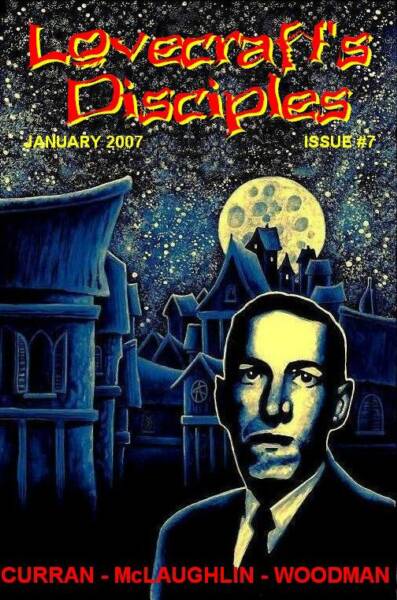 A couple of other bits of news before I sign off: issue 7 of 'Lovecraft's Disciples' arrived today, containing my tale 'The Sparkling Darkness'. It's not a brilliant story, and one that is heavily derivative of Thomas Ligotti's style, but nonetheless I'm quite pleased with it in my own small and cosmically insignificant way! Lovecraft's disciples can be ordered via Rainfall Records & Books, and is limited to 100 copies signed by the editor John B. Ford.
Finally, for those of you who want to see me 'in action' as it were: you can pop over to YouTube and check out the following link (I'm the one in the suit and tie). Thanks to Clai for this.
Wednesday, December 06, 2006
Full Details of Lovecraft Lectures
A reminder that seating for these talks is limited and it is recommended that tickets are booked in advance via Treadwell's Bookshop.
17 January 2007 (Wednesday)
HP Lovecraft and the Occult (Series of Four)
Evening One: The Man, the Myth, the Magic
Dr. Justin Woodman (University of London)
£5 in advance
7.15 for 7.30pm start
Treadwell’s presents Dr Justin Woodman’s series of four talks analysing aspects of HP Lovecraft (1890–1937), the author best known for the creation of the Cthulhu mythos, a fictional mythology detailing monstrous powers “from beyond”. Tonight, Woodman casts a critical eye on the “magical” context of Lovecraft’s life and work. He then explores some of the myths surrounding the man and his fiction. This first talk also begins to examine the powerful influence that Lovecraft’s unique literary creations have exerted over the contemporary occult imagination.
31 January 2007 (Wednesday)
HP Lovecraft and the Occult (Series of Four)
Evening Two: Legends of the Necronomicon
Dr. Justin Woodman (University of London)
£5 in advance
7.15 for 7.30pm start
In part two of this series, Justin Woodman explores the history of the legendary Necronomicon in fact and fiction, and ponders its continuing relevance to contemporary occult cultures. Penned by the Yemeni poet and mystic Abdul Alhazred circa 700 CE, the dreaded Necronomicon is perhaps one of the most powerful and alluring of HP Lovecraft’s creations: a grimoire able to rend apart the very fabric of reality and bring forth the Great Old Ones themselves. Although a work of fiction, the Necronomicon has yet achieved a social and physical reality with more than twenty versions having been published since the 1960s.
14 February 2007 (Wednesday)
HP Lovecraft and the Occult (Series of Four)
Evening Three: Chariots of the Dark Gods
Dr. Justin Woodman (University of London)
£5 in advance
7.15 for 7.30pm start
Many of H.P. Lovecraft’s best known tales of the Cthulhu mythos intimate that the human species is nothing but a by-product of extraterrestrial interventions in Earth’s prehistory. His idea predates the “Ancient Astronaut” theorists and “alternative archaeologists” by over thirty years. Woodman demonstrates that Lovecraft is a pervasive (but often unacknowledged) influence upon ufology and UFO religions. In the second part of the lecture, Woodman speculates further on the relationships that have developed between imaginative fiction, Forteana and contemporary occult cultures.
28 February 2007 (Wednesday)
HP Lovecraft and the Occult (Series of Four)
Final Evening: Chaos, Cthulhu, and Contemporary Consciousness
Dr. Justin Woodman (University of London)
£5 in advance
7.15 for 7.30pm start
Tonight’s talk concludes the series exploring the relationship between Lovecraft’s Cthulhu mythos and contemporary occult cultures. Woodman here focuses on Chaos magic and other recent movements, and considers the claim that Lovecraft was a “mythographer of modernity”. It can be argued that he was a writer whose enduring vision is consonant with the claims of cutting-edge magic and theoretical physics; moreover, Woodman suggests, his work intimates something about the current trajectories of Western culture and consciousness.
Dr Woodman lectures in anthropology at Goldsmiths College, Birkbeck College, and the University of Westminster. He has contributed articles on Lovecraftian themes to Strange Attractor and The Journal for the Academic Study of Magic.
17 January 2007 (Wednesday)
HP Lovecraft and the Occult (Series of Four)
Evening One: The Man, the Myth, the Magic
Dr. Justin Woodman (University of London)
£5 in advance
7.15 for 7.30pm start
Treadwell’s presents Dr Justin Woodman’s series of four talks analysing aspects of HP Lovecraft (1890–1937), the author best known for the creation of the Cthulhu mythos, a fictional mythology detailing monstrous powers “from beyond”. Tonight, Woodman casts a critical eye on the “magical” context of Lovecraft’s life and work. He then explores some of the myths surrounding the man and his fiction. This first talk also begins to examine the powerful influence that Lovecraft’s unique literary creations have exerted over the contemporary occult imagination.
31 January 2007 (Wednesday)
HP Lovecraft and the Occult (Series of Four)
Evening Two: Legends of the Necronomicon
Dr. Justin Woodman (University of London)
£5 in advance
7.15 for 7.30pm start
In part two of this series, Justin Woodman explores the history of the legendary Necronomicon in fact and fiction, and ponders its continuing relevance to contemporary occult cultures. Penned by the Yemeni poet and mystic Abdul Alhazred circa 700 CE, the dreaded Necronomicon is perhaps one of the most powerful and alluring of HP Lovecraft’s creations: a grimoire able to rend apart the very fabric of reality and bring forth the Great Old Ones themselves. Although a work of fiction, the Necronomicon has yet achieved a social and physical reality with more than twenty versions having been published since the 1960s.
14 February 2007 (Wednesday)
HP Lovecraft and the Occult (Series of Four)
Evening Three: Chariots of the Dark Gods
Dr. Justin Woodman (University of London)
£5 in advance
7.15 for 7.30pm start
Many of H.P. Lovecraft’s best known tales of the Cthulhu mythos intimate that the human species is nothing but a by-product of extraterrestrial interventions in Earth’s prehistory. His idea predates the “Ancient Astronaut” theorists and “alternative archaeologists” by over thirty years. Woodman demonstrates that Lovecraft is a pervasive (but often unacknowledged) influence upon ufology and UFO religions. In the second part of the lecture, Woodman speculates further on the relationships that have developed between imaginative fiction, Forteana and contemporary occult cultures.
28 February 2007 (Wednesday)
HP Lovecraft and the Occult (Series of Four)
Final Evening: Chaos, Cthulhu, and Contemporary Consciousness
Dr. Justin Woodman (University of London)
£5 in advance
7.15 for 7.30pm start
Tonight’s talk concludes the series exploring the relationship between Lovecraft’s Cthulhu mythos and contemporary occult cultures. Woodman here focuses on Chaos magic and other recent movements, and considers the claim that Lovecraft was a “mythographer of modernity”. It can be argued that he was a writer whose enduring vision is consonant with the claims of cutting-edge magic and theoretical physics; moreover, Woodman suggests, his work intimates something about the current trajectories of Western culture and consciousness.
Dr Woodman lectures in anthropology at Goldsmiths College, Birkbeck College, and the University of Westminster. He has contributed articles on Lovecraftian themes to Strange Attractor and The Journal for the Academic Study of Magic.
Tuesday, December 05, 2006
Lecture Series on Lovecraft at Treadwells
I'm giving series of four linked lectures on H.P. Lovecraft and the Occult at Treadwell’s bookshop in Covent Garden, London. The series will present a sceptical and critical assessment of the influence of Lovecraft’s Cthulhu mythos on contemporary ‘occultures’ (including Thelemic and Chaos magick, new religious movements, ufology and other fortean subjects) to suggest that Lovecraft’s work continues to offer a challenging point of reflection on the trajectory of modern culture and consciousness in the 21st century. The talks will also use Lovecraft’s writings as a springboard for exploring the relationship between the evolution of human cognition and imagination, the literature of the weird and the fantastic, and the nature and origins of magico-religious ideas. The first lecture is on Wednesday 17th January, and tickets cost £5.00. Dates and times of later lectures can be found at Treadwell's Bookshop.
Space is limited, so if you're interested, I'd suggested booking in advance (my last talk at Treadwells sold out).
Space is limited, so if you're interested, I'd suggested booking in advance (my last talk at Treadwells sold out).
Sunday, October 29, 2006
I am Lovecraft's disciple!
Things have been progressing slowly but surely on The al-Hazred Legacy. In the interim I've received some good news from John Ford at Rainfall Records & Books: John has kindly agreed to publish my short story 'The Sparkling Darkness' in issue 7 of Lovecraft's Disciples, due out Christmas 2006. Although not the first time my work has seen print, this will be my first published piece of fiction, and I'm well pleased about it.
Tuesday, October 03, 2006
A note on site content: The al-Hazred Legacy
I've been something of a roleplayer for well over 25 years (I even remember when the original D & D white box set was still available!). Sadly, I've had little time over the past 18 months to pursue my interest, resulting in my recently having to (yet again) let down a good friend of mine down after promising to run a Delta Green campaign for the umpteenth time. So, in lieu of actual gaming, I now intend to use this blog as a means for detailing initial development of my Lovecraftian indie rpg, tentatively titled The al-Hazred Legacy. If you're not sure what an 'indie' rpg is, check out The Forge for more info.
This will be my first attempt at game design, so I'm not sure how it will pan out; even so, I hope to have a rough-and-ready version available as a free pdf download by December 2006 (which I'll link to this site as and when). Clearly, I'm not going to be in much of a position to undertake rigorous playtesting of the initial version of the game, but I hope to address this problem post-December 2006.
The idea for The al-Hazred Legacy began as an attempt to put a Cthulhoid spin on Ron Edwards' Sorcerer rpg, but I've decided instead to take the bull by the horns and design the damned thing as an original game from the ground up. For the moment, all I can say about the game is that it will (hopefully) be something more than just an indie re-working of Chaosium's classic Call of Cthulhu rpg.
This will be my first attempt at game design, so I'm not sure how it will pan out; even so, I hope to have a rough-and-ready version available as a free pdf download by December 2006 (which I'll link to this site as and when). Clearly, I'm not going to be in much of a position to undertake rigorous playtesting of the initial version of the game, but I hope to address this problem post-December 2006.
The idea for The al-Hazred Legacy began as an attempt to put a Cthulhoid spin on Ron Edwards' Sorcerer rpg, but I've decided instead to take the bull by the horns and design the damned thing as an original game from the ground up. For the moment, all I can say about the game is that it will (hopefully) be something more than just an indie re-working of Chaosium's classic Call of Cthulhu rpg.
Thursday, September 28, 2006
Ghooric Zone undergoing...transformation
Apologies, dear reader, for the lack of content thus far. Hopefully this will change over the next week or so as Whispers from the Ghooric Zone undergoes some minor transformations, and I find a way of getting the site map (whatever that is) recognised by Google. One piece of news, though: my talk at Treadwells went down a treat, it seems, and at the suggestion of one Mr. Ash I have decided to expand the talk into a series of four lectures which will take place during January and February 2007.
Thursday, August 24, 2006
Tell Me, Have You Found the Ghooric Zone?
Whence comes the title of my blog? Seasoned Lovecraftians will already know; but for that small minority who a) actually end up reading my blog and b) are even interested, the Ghooric Zone is first mentioned by Lovecraft in his The Fungi from Yuggoth sonnet cycle, and later in his epistolary meanderings. However, my first encounter with this malign realm of abject extraterrestrial horror was in Richard Lupoff's story 'Discovery of the Ghooric Zone'. Originally published in 1977, Lupoff's tale did not see print again until a version was included in the Golden Anniversary edition of Tales of the Cthulhu Mythos issued by Arkham House in 1990. Thankfully, the story is now available online (see my links). This is one of my favourite Lovecraftian tales by an author other than the Old Gent of Providence, and manages to be both intimate and touching at the same time evoking an unearthly sense of cosmic awe worthy of HPL himself (though what he would have made of the interplanetary cyborg sex with which the tale opens is another matter entirely...). Also included is a link to Charles Stross' 'A Colder War'. Stross' recent collection The Atrocity Archive is strongly recommended, and this online tale gives a taste of the unique way the writer combines Le Carre with Lovecraft to create a new genre: the Cthulhoid spy thriller. Read and enjoy.
Yrs most cordially,
Justin
Yrs most cordially,
Justin
Subscribe to:
Posts (Atom)