Wednesday, June 20, 2018
The Lovecraftian Thing a Day (2018) No.171: The Slenderman Mysteries by Nick Redfern
Nick Redfern’s books are something of a guilty pleasure for me - his work is constituted of easily consumable, uncritical and problematically-researched takes on a range of pop-culturally-relevant paranormal and conspiratorial themes and ideas. I also consider him to be one of the more significant conduits by which Lovecraftian themes have been entering into contemporary paranormal, ufological and conspiratorial subcultures.
Needless to say, the shade of Lovecaft is invoked more than once in Redfern’s recent offering, The Slenderman Mysteries - unsurprising, given the acknowledged influence of Lovecraft’s work on this relatively recent piece of digital folk/fakelore. Simlarly, it has been recognised that the figure of Slenderman owes something to the modern ufological mythology of the Men in Black - an issue which Redfern explores in this book. Bear in mind the fact that I haven’t offered citations in support of the above claims, as I don’t want to be labelled a hypocritic in relation to what comes next (but message me if you require the relevant references, as I will be happy to provide them).
For my part, I’ve been predisposed toward the notion that the mythology of the MiBs was at least partially influenced by Lovecraft’s fiction: specifically, an early analogue of the MiB appears in Lovecaft’s Whisperer in Darkness - a tale which also involves an early fictive example of alien abduction. Indeed, in his They Knew Too Much About Flying Saucers, Gray Barker notes that Alfred Bender - who, via Barker’s book (and Bender’s own Flying Saucers and the Three Men) shaped early ufological lore concerning the Men-in-Black - was an avid fan of science-fiction literature.
In relation to which, for a brief moment, Redfern’s The Slenderman Mysteries offered me the hope of additional evidence in support of a Lovecraft-Bender-MiB link by way of the author’s claim that Bender was ‘a big fan of the writings of H.P. Lovecraft’. Sadly, as is the case with so much of the rhetoric of contemporary pop-cultural paranormal and conspiratorial texts, this is presented, via a kind of occulted illocutionary act, as an authoritative fact for which documentary evidence or appropriate citations in support of the claim are deemed uneccessary. Indeed, as with so much of this material, even where one does encounter the concrete citation of sources, these often direct one to either a wikipedia entry, or some other dubious, wholly uncritical and non-peer-reviewf online source. In this respect, more than once have I had to point out to a student the error of treating the number of referenced footnotes in the work of someone like David Icke as evidence of the author’s academic credentials.
Tuesday, June 19, 2018
The Lovecraftian Thing a Day (2018) No.170: NecronomiCon 2017 Commemorative Book
I received the first hint today (via Facebook) that preparations for NecronomiCon 2019 are underway - in anticipation of which, I present the commemorative convention book from NecronomiCon 2017, which contains a fine collection of art, essays, and short stories in celebration of the con.
Monday, June 18, 2018
The Lovecraftian Thing a Day (2018) No.169: Wentwood Tales - Creep
Wentwood Tales is an imprint of Three Imposters press dedicated to producing chapbooks of short-form weird fiction influenced by Arthur Machen and the Welsh landscape. The first of these is Jon Gower’s ‘Creep’ which, if I’m honest, doesn’t quite seem to launch the series off to an auspicious start. There are vague elements of Machenesque folk horror involved in the narrative, and on occasion ‘Creep’ echoes Machen’s style in its more sardonic phases; but overall there is nothing here which really seems to speak to a profound or primordial exploration of the metaphysical topography of rural Wales which one typically finds in Machen’s work; thus, whilst I approach this from the perspective of an uncouth southerner, this feels like a horror story set in Wales rather than a Welsh horror story.
That said, my anticipation is that the next two chapbooks in the series - Catherine Fisher’s ‘The Tunnel’ and Matthew G. Rees’ ‘The Word’ (and which should be winging their way to me as we speak) - may perhaps demonstrate a closer affiliation to Machenesque moods and themes; and in other respects, ‘Creep’ is to be commended: it is not, by any means, a bad piece of weird fiction - and as a chapbook is a high quality production with regard to the Three Imposters’ usual standards; in addition to which, it is great to see a resurgence of limited edition weird fiction chapbooks such as this in an increasingly digitised age.
Sunday, June 17, 2018
The Lovecraftian Thing a Day (2018) No.168: Palladium at Night
Today’s offering may be apposite in light of the release of the first episode of CBS’ Strange Angel: Palladium at Night (or PAN) is not only an actual spy satellite launched by an (as yet undisclosed) US intelligence agency in 2009, it is also the title of a limited edition novelette of weird/cosmic horror by Christopher Slatsky, which treats said satellite as the focal point of a tale of intersecting dimensions - and the weaponsation of time by a militarised NASA, employing occult technologies developed by none other than Jack Parsons.
Without giving too much away, Palladium at Night thus fits neatly into this blog’s recent run of conspiratorial Cold War Lovecraftian horror - although here we are dealing with a more inflected Lovecraftian cosmicism which veers in the direction of William Burroughs moreso than towards the trappings of the Cthulhu Mythos. One of my favourite purchases from NecronomiCon 2017, this really did not disappoint. Hopefully Palladium at Night will be made available again in a more accessible format at some point in the near future.
Saturday, June 16, 2018
The Lovecraftian Thing a Day (2018) No.167: The Book of the Lost
The Book of the Lost by Emily Jones and the Rowan Amber Mill provides the imagined soundtrack to a number of forgotten 1960s British horror movies, which were revived as part of an eponomously titled late night movie series which ran throughout the 1970s and early 80s. Everyone remembers The Book of the Lost - especially its haunting opening titles - although no one now can quite remember on which channel it aired (probably BBC2); curiously no listings of the series survive in the archives of the Radio Times (and no, you won’t find it on BBC Genome).
Perhaps only nominally Lovecraftian in that the synopses of two films - The Mash Thing and A Necklace of Shells - are very suggestive of Lovecraftian thenes, nonetheless The Book of the Lost is a nicely evocative piece of aural hauntological folk horror, reminding you of those Hammer and Amicus films that never were, but should have been.
Friday, June 15, 2018
The Lovecraftian Thing a Day (2018) No.166: The Rizen
We return once more to Cold War Lovecraftiana with 2017’s The Rizen: a low budget British sci-fi horror movie set in a underground military installation (Kelvedon Hatch) in the 1950s, and concerning the aftermath of a secret programme involving experimentation with an occult physics, sponsored by a sinister British government department. Needless to say, there is a heavy, if not overt, Lovecraftian overtone to the movie - and both the premise and setting of The Rizen held the promse of something very unique; in addition to which, the film also includes cameos by some very solid British actors such as Ade Edmonson, Sally Phillips, Tom Goodman and Julian Rhind-Tutt.
Unfortunately, these occasional star turns are not enough to lift the acting skills of the principle players, whose abilities for far too much of the film seem unable to rise above the level of a rather provincial amatuer dramatics society; the setting of Kelvedon Hatch is also underused, focusing on the same two or three corridors for most of the film. In addition to which, the action scenes are not terribly exciting, and the horror elements are handled poorly. In many of the above respects, it seems that the initial promise of The Rizen was always going to be undermined by its low budget.
In fairness, though, it is worth a watch as a featuring something of an original setting for a piece of Lovecraftian horror - and apparently a sequel is in production (hopefully with a bigger budget).
Thursday, June 14, 2018
The Lovecraftian Thing a Day (2018) No.165: The Delaware Road
It’s questionable whether the rhizomic beast which is The Delaware Road could formally be described as Lovecaftian; yet there are a number of tangential Lovecraftian associations arising from it which, I think, nominally legitimate said classification.
What, then, is The Delaware Road? Played out across multiple media platforms (a cd, a performance piece, a poem and a partial screenplay) The Delaware Road is an event which encapsulates elements of folk and speculative horror: powerfully influenced by the work of Nigel Kneale, cosmic and otherworldy forces manifest by way of strange occult rituals encoded in the audio archives of the BBC’s Radiophonic Workshop (originally based in the Delaware Road, London), all the while intersecting with nightmarish bureaucracies, the threat of nuclear apocalypse, and Cold War paranoia in 1960s Britain.
A chilling spoken word piece - fraught with occult significance - provided by Dolly Dolly (whose Lovecraftian pedigree is evident in his recently released A Dollop of HP) is the fulcrum of The Delaware Road, framed by various hauntological scores evocative not only of classic, optimistically speculative 1970s British TV shows as Tomorrow’s World, but also of the far more terrifying atonal experimental electronic sounds which formed the backdrop to so many of the folk-horrific children’s programming of the period (think Children of the Stones).
I had the good fortune to witness The Delaware Road performed in the setting of Kelvedon Hatch Nuclear Bunker in 2017.
Built in the 1950s, Kelvedon Hatch was a Cold War era bunker meant to function as the site of regional government in the event of a nuclear strike against the UK. Decommissioned in the early 1990s, it has since become something of a cult tourist attraction. Its functional, brutalist architecture - alongside the now-retro but strangely unsettling machinery dotted about the place - gives Kelvedon Hatch bunker the Quatermassian/Lovecraftian feel of a location in which nameless experiments using largely incomprehensible technolgies and occult physics once quite likely may have taken place; this may be the precise reason why The Rizen was filmed there, also in 2017: a low-budget British science-fiction horror movie, The Rizen takes as its central conceit the weaponisation of occult physics by the British military in the 1950s, with the intention of calling forth Lovecraftian horrors from beyond time and space.
Perhaps one of the most curious aspects of the Kelvedon Hatch performance of The Delaware Road was the appearance of British snooker superstar Steve ‘Interesting’ Davis, who was wandering around the event looking vaguely lost; apparently not - he has, it seems, an abiding interest in avante garde electronica, and lives in the vicinity of Kelvedon Hatch. The universe is, it turns out, stranger and far more incomprehensible than we thought.
As something of an aside, regular readers of this blog might be interested to know that the Kelvedon Hatch performance of The Delaware Road also formed the basis of one of the field reports from last year’s Horsingdon Transmissions.
So there we have it - The Delaware Road forms a curious bookend to the last few days of Cold War-themed Lovecraftiana. And in this I am reminded of a point which Charles Stross raises in the afterword to The Atrocity Archives: that there is something about the Cold War (at least for those of us who lived through it) which frames it as an intrinsically Lovecraftan moment, when billions of people stood powerless against the cold indifference of vast state apparatus - an apparatus which treated its citizenry as little more than a statistical problem in the aftermath of unleashng monstrously destructive cosmic forces in the name of abstract and meaningless ideologies.
Wednesday, June 13, 2018
The Lovecraftian Thing a Day (2018) No.164: Hot War
Set in the same alternative history as Cold City, Hot War reimagines the Cuban missile crisis as precipitating an apocalyptic Third World War: one forged not only from the fires of nuclear fission, but as a result of the deployment of incomprehensible esoteric technologies harvested from Nazi Germany by Britain, America, and the Soviets.
Here a devestated London - over which the provisional government only just manages to maintain control - forms the focal point of the game, where players are trying to deal with the harsh realities of martial law, sedition, unnameable monstrosities summoned from beyond time and space through the use of weaponised arcane machineries - and of course, foreigners.
Imagine Wyndham meets Ballard meets Lovecraft by way of Charles Stross and Tarkovsky, played out against the background of Threads and the emboldened xenophobia of Brexit, to produce a peculiar and horrifying British post-war bleakness.
Tuesday, June 12, 2018
The Lovecraftian Thing a Day (2018) No.163: Cold City - The Dossier
Cold City: The Dossier is a supplement - of sorts - for the Cold City rpg, consisting of a number of documents - letters, reports, technical diagrams, and the like - for use as scenario plot hooks in the game. As such, Cold City: The Dossier is system neutral (containing no game mechanics), and can thus be read independently as work of short fiction in the vein of the Delta Green universe or Charles Stross’ A Colder War. Indeed, there are hints throughout the disparate documents intimating that they are perhaps fragments which, collectively, form part of a larger narrative whole. But in true Lovecraftian fashion this is inferred and left to the reader’s imagination - indeed, the obtuse nature of The Dossier’s various documents is such that the monstrous is portended or spied fleetingly, but rarely confronted directly: in the words of one US agent quoted in The Dossier, ‘The full horror of what we are discovering is, in my considered opinion, yet to be revealed. I have a deep, unswerving belief that we are teetering on the edge of a black abyss’. Nice.
Monday, June 11, 2018
The Lovecraftian Thing a Day (2018) No.162: Cold City
Cold City is an rpg of monster-hunting in 1950s Berlin, wherein members of a multi-national task force navigate internal conflict and burdgeoning Cold War paranoia, all the while unravelling a secret history of World War Two as they deal with the aftermath of Nazi experimentation with alien, prehuman and occult technologies - technologies whose existence threatens the very fabric of reality.
Whilst the game doesn’t explicitly reference Lovecraft or the Cthulhu mythos, those influences lurk heavily about the game (whose background is, in any case, drawn in very broad strokes) - as does a dark thread of nihilism and dread in the face of potential nuclear apocalypse (or worse) in a fraught post-war political landscape in which each of the players have a stake. These intersect with the unspoken Lovecraftian tenor of Nigel Kneale’s Quatermass series which also works its way into the world of Cold City. One of the darkest and most depressing rpgs I have ever played - thus a strong recomend from me.
Sadly, Cold City hasn’t received much by way of support since its initial publication in the mid-2000s, but it remains available in pdf format at rpgnow.
Sunday, June 10, 2018
The Lovecraftian Thing a Day (2018) No.161: Alchemy of Dreams and Other Poems by Michael Fantina
Weird and Lovecraftian poetry has, sadly, suffered another loss by way of the recent passing of Michael Fantina. I first encountered Fantina’s work by way of Rainfall Books’ 2009 chapbook Flowers of Nithon - an homage to Lovecraft’s Fungi from Yuggoth sonnet cycle, and which was a strong recommend when it appeared back in 2016’s Lovecaftian Thing a Day.
More recently I picked up Alchemy of Dreams and Other Poems, published by Hippocampus Press (I have a feeling that this may also contain Flowers from Nithon, but currently I don’t have the physical book to hand), during NecronomiCon 2017 - this looks as if it is planned as the first volume of Fantina’s collected poetical works. (whose career, by the way, spanned four decades). Alchemy of Dreams currently resides on my ‘to read’ pile, but as I am planning a Summer of reading weird poetry, I hope to revist Fantina’s fine work shortly.
Saturday, June 09, 2018
The Lovecraftian Thing a Day (2018) No.160: Cthulhu Adventus
Today’s offering is a slightly odd one, as it relates to a product which remains, sadly, vapourware - but one which I was very eager to get my hands on. Dating back to 2007, Cthulhu Adventus was first announced as part of Chaosium’s Miskatonic University Monograph series; this never appeared, and sometime around 2010 the producers of the supplement slated it for a 2013-14 publication, this time as a liscenced product under the auspices of Stygian Fox. Whilst Stygian Fox have continued to produce a number of supplements for the Call of Cthulhu rpg, Cthulhu Adventus has yet to appear.
What was teased about Cthulhu Adventus on its dedicated blog (which remains live despite not having been updated since 2010) was the intriguing premise of a dystopian Lovecraftian 1984, in which the Earth has fallen under the dominion of the totalitarian Humanitarian Political Party, or the Polity, which exerted absolute control - Big Brother style - over the surviving populace of a post-apocalyptic Europe in the face of the horrors of the Cthulhu mythos. At the time this central conceit struck me as wholly believable in relation to how a totalitarian state would seek to ‘protect’ its populace in the face of the reality of the Great Old Ones - a notion which is also expertly explored in Basil Copper’s classic mythos tale ‘Shaft Number 247’.
One of the themes which seemed to emerge from the few background details made public regarding Cthulhu Adventus was the notion that the fascistic Polity would go to extreme lengths - even to the extent of exterminating large numbers of its own citizens - in order to keep knowledge of the mythos secret (as I recall, this was rather horribly implied in a recorded playthrough of an early Cthulhu Adventus scenario which appeared on yog-sothoth.com): a case of destroying the village in order to save it - a context in which player characters as agents of the Polity might potentially be faced with some stark and deeply-troubling moral choices; in this respect, there was an implication that the setting might also explore questions regarding the nature of the monstrous in relation to how, under the auspices of thehighly-rationalised bureaucracies of modern neoliberal bation states, we ourselves are already subjects of the monstrous, indifferent forces of our own ‘Great Old Ones’.
In any case, I remain hopeful that, at some point in the future, Cthulhu Adventus may yet see the light of day.
Friday, June 08, 2018
The Lovecraftian Thing a Day (2018) No.159: Herald: Lovecraft & Tesla
When it comes to roleplaying games, my tastes tend to gravitate towards two flavours: old school, and Savage Worlds. Herald: Lovecraft & Tesla is a setting for the latter, based on a comic of the same name, which brings a pulpy steampunk feel (genres which Savage Worlds serves well) to the world of the Cthulhu mythos. This this the Kickstarter edition of the game, which came with Lovecraft & Tesla-themed poker chips and playing cards (both of which have a mechanical function in the Savage Worlds rules set).
Not sure that I will play this rather than plunder it for ideas to use in other Cthulhu-themed Savage Worlds games, but the peripherals are rather nice as pieces of Lovecraftian ephemera.
Thursday, June 07, 2018
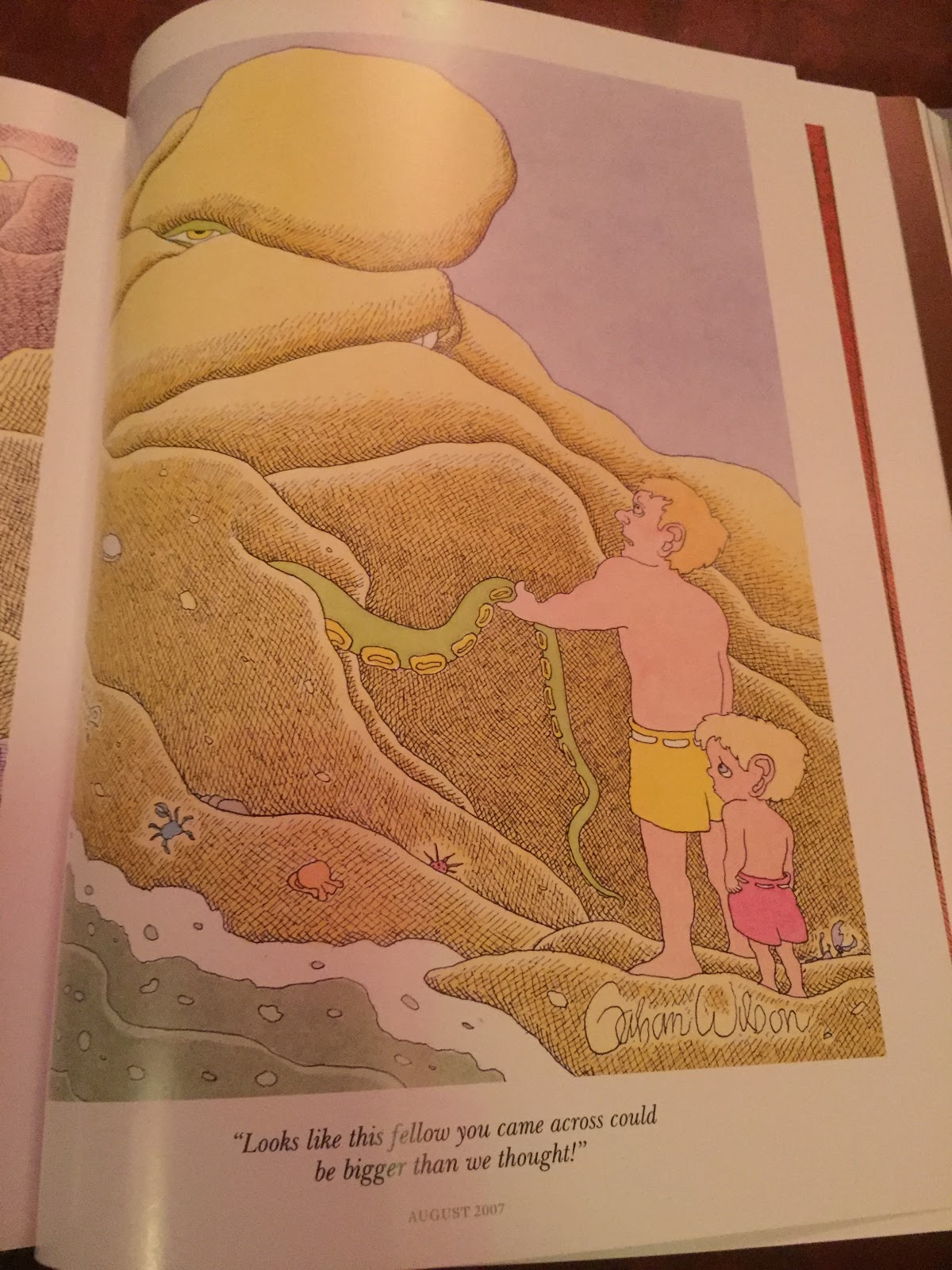
The Lovecraftian Thing a Day (2018) No.158: Gahan Wilson’s 50 Years of Playboy Cartoons
Whilst 50 Years of Playboy Cartoons isn’t exactly a tome of Lovecraftian terrors, it is replete with enough ghouls, bug-eyed monsters, ghastly critters and betentacled things rendered in Wilson oddly quaint and charming style to warrant a place alongside other collections of weird art. And fear not - despite its title, there is nothing racy, titillating or downright pornographic in this lovely three volume set. Although knowing some of you, that will no doubt come as something of a disapointment.
Thanks to Matthew Carpenter of the Lovecraft eZine and editor at Ulthar Press for pointing me in the directin of this.
Wednesday, June 06, 2018
The Lovecraftian Thing a Day (2018) No.157: Lovecraftian Ouija Board
Today’s offering is a slightly-larger-than-A4 sized Lovecaftian ouija board which I acquired scant days ago. I am rather fond of such curiosities (I currently possess three mythos-themed boards) - despite their existence (like that of Lovecraftian tarot cards) being something of an affront to the central materialistic conceits of the ‘canonical’ Lovecaftian universe; indeed, an issue I havevlong hand with contemporary occultism is the lack of imagination it seems to have when it comes to occulturing Lovecraft, always trying to crowbar something wholly alien and unknowable into extant, all-too terrestrial and anthropocentric esoteric traditions. Ligotti’s tale ‘The Spectacles in the Drawer’ is instructive is this regard.
This will probably end up being mounted on one of the walls of my study - a reminder of the seemingly-limitless expanse of the field of human folly.
Tuesday, June 05, 2018
The Lovecraftian Thing a Day (2018) No.156: Necronomicon Bookmark
My latest ‘creation’: a black velvet bookmark with silver ‘elder sign’ charms attached to either end. I have given it the especially imaginative title of ‘The Necronomicon Bookmark’. This version of the elder sign is, of course, the one designed for the Simon Necronomicon (its creator was Khem Caigan, as I recall) - not a design I’ve been overly fond of, but I think it looks quite effective here.
Monday, June 04, 2018
The Lovecraftian Thing a Day (2018) No.155: Banshee Chapter
I have an almost uncritical love of the found footage genre - in part because it is a style of film-making that offers the pssibility of replicating, in vsual terms, some key aspects of Lovecraftian horror: both the use of a first-person perspective in which the ultimate horror is only hinted at, spied tangentially or at a distance; and the unravelling of a terrifying narrative through the discovery of various documents and accounts - Lovecraft’s The Call of Cthulhu being a classic example, along with other genre classics such as Machen’s The White People, Bloch’s Notebook Found in a Deserted House, and Hodgson’s The House on the Borderland. Today’s offering is part of an occasional series which looks at found footage films with explicit Lovecraftian content, or with strong Lovecraftian overtones.
2014’s Banshee Chapter is a reimaging of Lovecraft’s From Beyond in light of government conspiracies, the creepy mythology of numbers stations, and the CIA’s MK-ULTRA secret drug-testing programme. Interestingly, Banshee Chapter also mirrors a more recent conspiratorial narrative which has been making the rounds since the 2010s which is a revisioning of the classic notion that the US government has made a secret treaty with extraterrestrials, but which in this new, somewhat desecularised version of the myth holds that government agencies have made contact with otherworldly/interdimensional beings through the use of occult rituals.
In any case, Banshee Chapter effectively builds up a sense of creeping dread - if not outright cosmic horror - and is a strong recommend as far as Lovecraftian cinematic horror is concerned. One key point, though: whilst Banshee Chapter has elements of/is filmed in a found footage/documentary style, it isn’t, properly speaking, a found footage film (there is no acknowledgement of the cameraperson as part of the narrative). I’m not sure if ths has been picked up on in many reviews, but it adds another layer of mystery to an already strange film: if the protaganists are being filmed, but don’t realse this is the case, exactly who - or what - is filming them?
Sunday, June 03, 2018
The Lovecraftian Thing a Day (2018) No.154: Carcosa
The classic Eurogame Carcasonne gets a Lovecraftian/Chambers reskin in Carcosa. I’ve not played this yet, but it is beautifully-produced - with cultist and King in Yellow meeples, as well as gorgeously-eldritch full-colour glossy gaming tiles - and comes with a solo option.
Carcosa is made by One Free Elephant. And they’re not lying in that regard: on opening the box, you do, indeed, get one free elephant.
Saturday, June 02, 2018
The Lovecraftian Thing a Day (2018) No.153 Averoigne
As I mentioned yesterday, Smith never quite grabbed my attention in the way that Lovecraft and Howard did (although I have a greater appreciation of his work today than when I was engaged in my earliest explorations of weird fiction); even so, I was drawn to his tales of Averoigne - I think because they seemed to resonate more closely than Smith’s other stories did with the kind of fantasy fare which I was also reading at the time (late1970’ - early 1980s). This was compounded by the discovery of Module X2 Castle Amber for the D&D Expert edition, which rather deftly wove characters, creatures and plots from the Averoigne tales (with elements of Poe and Lovecraft added) into an extremely well-plotted scenario - and which doubled as a sandbox setting allowing player characters to enter and explore the horror-haunted world of Averoigne itself. Not only does this remain my single favourite D&D module, but I consider it to be something of an unacknowledged blueprint for the gothic horror-inspired Ravenloft, which appeared about a decade later (and remains to this day a classic and well-loved staple of D&Ds game worlds). Castle Amber was one of 2016’s offerings, but is also included here (with its hexcrawl map of Averoigne) in a newly-available print-on-demand version - because one copy is never enough...
Friday, June 01, 2018
The Lovecraftian Thing a Day (2018) No.152: The Complete Poetry and Translations by Clark Ashton Smith
I’m not quite sure how I missed Hippocampus Press’ three volume set of Clark Ashton Smith’s The Complete Poetry and Translations, published back in 2012 - although of the classic Weird Tales triumvirate, I’ve always been more drawn to Lovecraft and Howard, with my interest in Smith being largely limited to his contributions to the Cthulhu mythos.
However, in the last five years or so I have become increasingly drawn to weird poetry and, after having the opportunity to hear and meet (albeit briefly) poet and Smith-afficianado Donald Sidney-Fryer at last year’s NecronomiCon, I’ve decided to further investigate Clark Ashton Smith’s poetry; and I have to admit that, whilst I was aware that Smith thought of himself primarily as a poet, I hadn’t realised that he had written so much of the stuff.
The first two volumes of this set contain Smith’s own varied verse (including the weird classic, The Hashish Eater), whilst the final volume contains his translations into English the work of various Spanish- and French-speaking poets - including Baudelaire’s Les Fleurs du Mal (which I haven’t read in many years). In any case, my plan is to immerse myself in the history of weird poetry during the Summer, which will hopefully involve delving more deeply into the contents of these wonderful tomes.
Subscribe to:
Posts (Atom)